
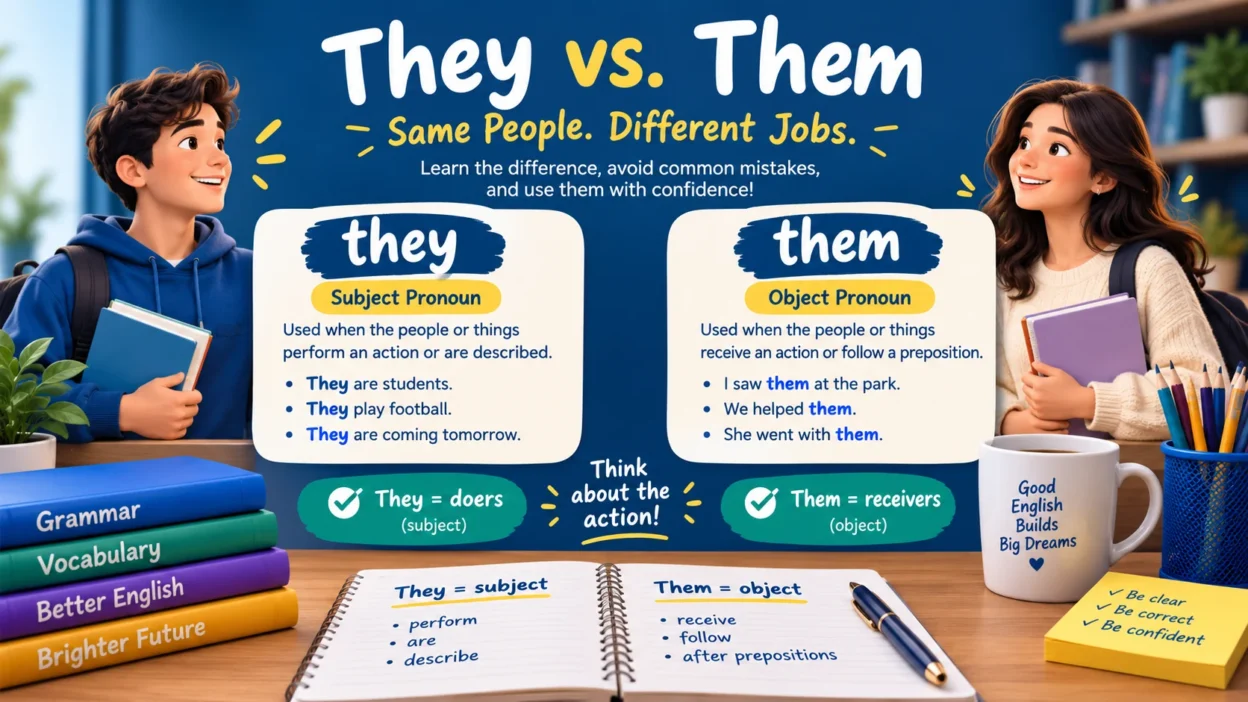
Understanding the difference between they vs. them is essential for speaking and writing correct English. Both words are pronouns used to refer to people or things, but they serve different grammatical roles in a sentence. Choosing the right one can make your sentences clearer and help you avoid common grammar mistakes.
The main difference is that “they” is a subject pronoun, while “them” is an object pronoun. Use “they” when the people or things perform an action, and use “them” when they receive an action or follow a preposition. For example, “They invited us to dinner” is correct because “they” performs the action. In contrast, “We invited them to dinner” is correct because “them” receives the action. Both words can refer to multiple people, and both can also be used when referring to a single person whose gender is unknown, irrelevant, or when that person uses they/them pronouns. Learning how these pronouns work will help you choose the correct word in everyday conversations, emails, academic assignments, and professional writing.
Quick Answer: They vs. Them
They is a subject pronoun used for someone performing an action, while them is an object pronoun used for someone receiving an action or following a preposition. Say “They are happy,” but “I saw them.” Both pronouns can refer to multiple people or to one person, depending on context.
Why Do People Confuse They and Them?
People often confuse “they” and “them” because both pronouns can refer to the same people or person. The difference is not usually about meaning; it is about the grammatical role each pronoun plays.
Consider these examples:
- They are my classmates.
- I study with them.
- They called me yesterday.
- I called them yesterday.
In each pair, the pronouns refer to the same people, but their roles change.
Three common reasons for confusion are:
- Similar meanings: Both words can refer to the same individuals.
- Fast conversation: Speakers sometimes choose a pronoun based on how a sentence sounds rather than its grammatical structure.
- Longer sentences: Expressions such as “between you and them” or “they and I” can make the correct choice less obvious.
The easiest solution is to identify who performs the action and who receives it.
What Does “They” Mean?
They is a subject pronoun. It replaces a noun or name when that person or group performs an action or is described in a sentence.
When Should You Use They?
Use “they” in these situations:
1. When referring to multiple people
- They work at the same company.
- They are waiting outside.
- They enjoy playing football.
2. When referring to multiple things or animals
- The books are expensive because they are imported.
- The dogs are hungry because they missed breakfast.
3. When referring to one person
Singular “they” is appropriate when a person’s gender is unknown or irrelevant, or when the person uses they/them pronouns.
- Someone left their phone. They may come back for it.
- Alex said they would join us later.
- My new colleague is friendly. They helped me yesterday.
Example Sentences With They
- They are learning English.
- They finished their homework early.
- They want to visit London.
- They have already arrived.
- They were excited about the news.
In each example, “they” functions as the subject.
What Does “Them” Mean?
Them is an object pronoun. It replaces a noun or name when that person or group receives an action or follows a preposition.
When Should You Use Them?
Use “them” in these situations:
1. When someone receives an action
- I called them this morning.
- She invited them to her birthday party.
- We helped them with their project.
2. After a preposition
- I went shopping with them.
- The teacher spoke to them.
- This gift is for them.
3. When referring to one person
“Them” can also refer to a single person who uses they/them pronouns or when the person’s gender is unknown or irrelevant.
- I met Jordan yesterday and spoke with them.
- Someone forgot their bag, so I gave it to them.
- Taylor said the decision was important to them.
Example Sentences With Them
- I saw them at school.
- Please send them the information.
- We waited for them outside.
- The manager thanked them.
- I sat beside them during the meeting.
In each example, “them” functions as an object.
They vs. Them: Comparison Table
| Feature | They | Them |
|---|---|---|
| Grammatical role | Subject pronoun | Object pronoun |
| Main function | Performs an action or is described | Receives an action or follows a preposition |
| Common position | Before the main verb | After a verb or preposition |
| Plural example | They are ready. | I saw them. |
| Singular example | They are my friend. | I spoke to them. |
| Correct question | Who is doing it? | Whom is the action directed toward? |
Remember that sentence structure matters more than a pronoun’s position alone. “They” can appear after a verb in some constructions, such as “The winners were they,” although this sounds formal. In everyday English, the most useful distinction is subject versus object.
When Should You Use They or Them?
The best way to choose between these pronouns is to examine how the word functions in the sentence.
Use They for the Subject
Choose “they” when the pronoun performs an action or serves as the subject of a sentence.
- They play basketball every weekend.
- They understand the instructions.
- They are coming to the party.
- They seem very confident.
Ask yourself: Who is performing the action?
If the answer is the people or person you are referring to, “they” is usually the correct choice.
Use Them for the Object
Choose “them” when the pronoun receives an action or follows a preposition.
- I called them last night.
- We invited them to dinner.
- The teacher explained the lesson to them.
- She went with them to the library.
Ask yourself: Who receives the action, or who follows the preposition?
If the answer is the people or person you are referring to, use “them.”
What About “They and I” vs. “Them and Me”?
The same subject-object rule applies when a pronoun appears alongside another person.
- They and I went to the market. (Subject)
- The teacher praised them and me. (Object)
- She spoke to them and us. (Object after a preposition)
A helpful test is to remove the other person from the sentence:
- “They and I went” becomes “They went.”
- “The teacher praised them and me” becomes “The teacher praised them.”
This simple method helps you select the correct pronoun.
12 Examples of They vs. Them in Sentences
Here are practical examples that show how the two pronouns work in everyday English.
| No. | Sentence | Why It Is Correct |
|---|---|---|
| 1 | They are my best friends. | “They” is the subject. |
| 2 | I met them yesterday. | “Them” receives the action. |
| 3 | They study English every day. | “They” performs the action. |
| 4 | We helped them with their homework. | “Them” receives help. |
| 5 | They went to the cinema. | “They” is the subject. |
| 6 | I went to the cinema with them. | “Them” follows “with.” |
| 7 | They have finished the assignment. | “They” is the subject. |
| 8 | The teacher congratulated them. | “Them” receives congratulations. |
| 9 | Someone is at the door. They are waiting for you. | Singular “they” is the subject. |
| 10 | I spoke to someone, but I forgot their name. I will ask them later. | Singular “them” is the object. |
| 11 | They gave the documents to us. | “They” performs the action. |
| 12 | We gave the documents to them. | “Them” follows “to.” |
More Examples in Short Conversations
Conversation 1
- A: Who is coming to dinner?
- B: They are coming at seven.
Conversation 2
- A: Did you see your cousins?
- B: Yes, I saw them yesterday.
Conversation 3
- A: Who is your new teammate?
- B: Alex. I spoke with them this morning.
These conversations show how naturally the pronouns appear in everyday speech.
Common Mistakes With They and Them
Even fluent English speakers sometimes make pronoun mistakes, particularly in informal conversation.
Mistake 1: Using Them as the Subject
Incorrect: Them are my friends.
Correct: They are my friends.
Why? “They” is required because the pronoun is the subject of the sentence.
Mistake 2: Using They as the Object
Incorrect: I called they yesterday.
Correct: I called them yesterday.
Why? “Them” receives the action of the verb “called.”
Mistake 3: Using They After a Preposition
Incorrect: I went shopping with they.
Correct: I went shopping with them.
Why? Object pronouns follow prepositions such as “with,” “to,” “for,” and “between.”
Mistake 4: Confusing Singular They With Them
Incorrect: I spoke to they about the problem.
Correct: I spoke to them about the problem.
Why? Singular “they” and singular “them” refer to the same person in appropriate contexts, but their grammatical roles remain different.
Mistake 5: Choosing a Pronoun Based on the Nearest Noun
Incorrect: My brother told my sister and they the news.
Correct: My brother told my sister and them the news.
Why? “Them” is the object of “told” in this construction. The fact that another noun appears immediately before the pronoun does not change the grammatical rule.
Memory Trick: How to Remember They vs. Them
Use this simple memory trick:
- They = doers.
- Them = receivers.
For example:
- They kicked the ball. (They perform the action.)
- The ball hit them. (They receive the action.)
You can also compare “they” with other subject pronouns and “them” with other object pronouns.
| Subject Pronouns | Object Pronouns |
|---|---|
| I | Me |
| He | Him |
| She | Her |
| We | Us |
| They | Them |
If you already know that “I” is used as a subject and “me” as an object, remembering “they” and “them” becomes easier.
They vs. Them in American and British English
There is no major grammatical difference between American and British English when it comes to “they” and “them.” Both varieties follow the same basic subject-object distinction.
Examples in American English:
- They are going to the store.
- I saw them at the mall.
Examples in British English:
- They are going to the shop.
- I saw them at the shopping centre.
The nouns “store,” “shop,” “mall,” and “shopping centre” vary by region, but the pronoun rules remain the same.
Both American and British English also use singular “they” in appropriate contexts. In formal writing, academic work, and professional communication, choose the pronoun according to its grammatical role and the intended meaning.
Similar Words: They, Them, Their, and Theirs
“They” and “them” are closely related to “their” and “theirs,” but each word has a different function.
| Word | Grammatical Role | Example |
|---|---|---|
| They | Subject pronoun | They are studying. |
| Them | Object pronoun | I helped them. |
| Their | Possessive determiner | Their house is large. |
| Theirs | Possessive pronoun | That house is theirs. |
They vs. Their
Use “they” as the subject and “their” before a noun to show possession.
- They are my neighbors.
- Their house is near the park.
Them vs. Their
Use “them” as an object and “their” to indicate ownership.
- I invited them to dinner.
- Their dinner is ready.
They vs. Theirs
“They” refers to people or things as the subject, while “theirs” indicates that something belongs to them.
- They are waiting outside.
- The blue bags are theirs.
Understanding these four words will help you avoid many common English pronoun errors.
Final Verdict: They or Them?
The correct choice depends on the pronoun’s grammatical role.
- Use they when the person or people are the subject: “They called me.”
- Use them when the person or people are the object: “I called them.”
- Use they and them for a single person when appropriate, including when that person uses they/them pronouns.
Neither word is inherently more formal or more correct than the other. Both are standard English pronouns, and each is correct in its proper grammatical position.
Frequently Asked Questions
1. What is the main difference between they and them?
“They” is a subject pronoun, while “them” is an object pronoun. Use “they” for the person or people performing an action and “them” for the person or people receiving an action or following a preposition.
Examples: “They helped us” and “We helped them.”
2. Is it correct to say “they” or “them”?
Both are correct, but they are used differently. “They” is correct as a subject, as in “They are here.” “Them” is correct as an object, as in “I saw them.”
The surrounding sentence determines which pronoun you need.
3. Can they and them refer to one person?
Yes. Singular “they” and “them” can refer to one person whose gender is unknown or irrelevant, or someone who uses they/them pronouns.
For example: “Jordan is here. They brought a book, and I gave them a pen.”
4. Should I say “me and them” or “they and I”?
It depends on the sentence’s grammatical role.
Use “they and I” when the pronouns are the subject: “They and I work together.”
Use “them and me” when the pronouns are the object: “The manager thanked them and me.”
5. Is “them” grammatically correct at the beginning of a sentence?
It can be correct when it functions as an object within the sentence, but it is not normally used as the subject of a standard declarative sentence.
- Correct: “Them, I can understand.” This is a marked construction that emphasizes the object.
- Standard: “They understand me.”
For ordinary writing, use “they” when the pronoun is the subject.
6. Is singular they grammatically correct?
Yes. Singular “they” is an established part of modern English. It can refer to a person whose gender is unknown or to someone who uses they/them pronouns.
Example: “A student left their notebook. They can collect it tomorrow.”
7. How do I quickly decide between they and them?
Identify the pronoun’s role. If it performs the action or serves as the subject, use “they.” If it receives the action or follows a preposition, use “them.”
Compare “They invited us” with “We invited them.”
Remember This
- They = subject: They are ready.
- Them = object: I called them.
- They can refer to one person or multiple people.
- Them can also refer to one person or multiple people.
- After prepositions such as “with,” “to,” and “for,” use “them” in standard constructions.
- The correct choice depends on grammar, not on whether you are referring to one person or a group.
Conclusion
The difference between “they” and “them” is simple once you understand subject and object pronouns. Use “they” when someone performs an action or serves as the subject of a sentence. Use “them” when someone receives an action or follows a preposition. These rules apply in both American and British English, and they also apply when using singular “they” to refer to one person.
To improve your English, practise identifying the subject and object in everyday sentences. Remember the examples “They helped me” and “I helped them.” With regular practice, you will learn to choose the right pronoun naturally in conversations, emails, school assignments, and professional writing.

David Henry is a language enthusiast and content writer specializing in synonyms, vocabulary, and word meanings. He creates clear, engaging resources that help readers improve their writing, communication, and English skills.