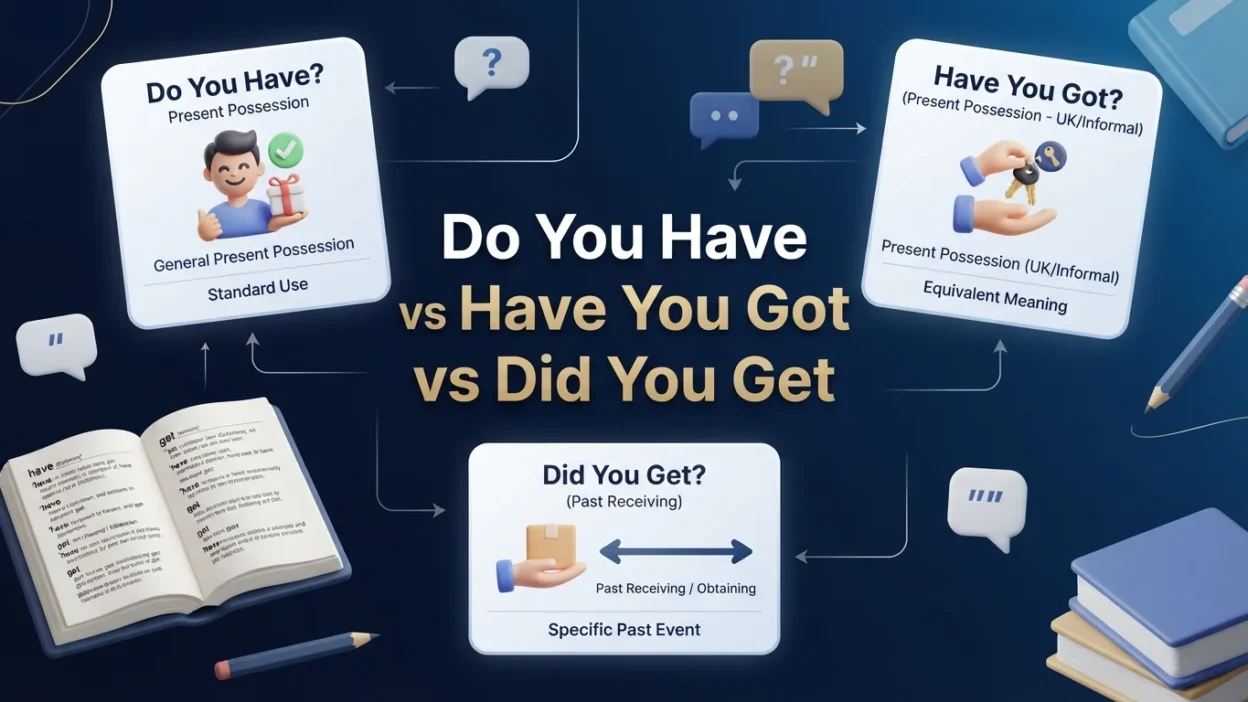
When talking about possession, availability, or something someone received, English learners often confuse “Do you have,” “Have you got,” and “Did you get.” They may look similar, but they are used for different purposes. “Do you have” and “Have you got” usually ask whether someone possesses or has something, while “Did you get” usually asks whether someone received, obtained, or understood something in the past.
Understanding these expressions becomes much easier when you focus on the meaning and time of the question. This guide explains their differences with simple examples, a comparison table, common mistakes, and practical rules for everyday American and British English.
Quick Answer
“Do you have?” and “Have you got?” usually mean the same thing when asking about possession or availability. “Did you get?” normally refers to a past action, such as receiving, obtaining, or understanding something. Choose the expression based on whether you mean having something now or getting something in the past.
Why Do People Confuse Them?
The confusion happens because all three questions can be used in everyday conversations involving the same object.
For example:
- Do you have a pen? → Are you carrying or possessing a pen now?
- Have you got a pen? → Do you have a pen now?
- Did you get a pen? → Did you receive or obtain a pen?
The key difference is the verb:
- have = possess or experience
- have got = usually possess or have
- get = receive, obtain, acquire, or sometimes understand
First Word: “Do You Have?”
“Do you have?” is a common way to ask whether someone possesses or has something.
It normally uses the present simple:
Do + subject + have + object?
Examples
- Do you have a car?
- Do you have any money?
- Do you have a question?
- Do you have my book?
- Do you have enough time?
It can also ask about availability:
Do you have a table for two?
Here, the speaker is asking whether a table is available.
“Do you have” is especially common in American English, although it is completely normal in British English too.
Second Word: “Have You Got?”
“Have you got?” commonly means the same as “Do you have?” when talking about possession, relationships, or things someone has available.
Examples:
- Have you got a car?
- Have you got any money?
- Have you got a sister?
- Have you got a pen?
- Have you got enough time?
In this use, “have got” is a present-time expression.
For example:
Have you got a phone charger?
This usually means:
Do you have a phone charger?
It does not normally mean “Did you receive a phone charger?”
Comparison Table
| Expression | Main meaning | Time | Example |
|---|---|---|---|
| Do you have? | Possess or have something | Present | Do you have a car? |
| Have you got? | Possess or have something | Present | Have you got a car? |
| Did you get? | Receive, obtain, acquire, or understand | Past | Did you get a car? |
The simplest rule
If you mean “Do you possess/have it now?”, use:
- Do you have…?
- Have you got…?
If you mean “Did you receive/obtain it?”, use:
- Did you get…?
When Should You Use Each Expression?
Use “Do You Have?” for Present Possession
Use it when asking whether someone has something now.
Do you have a passport?
Do you have your keys?
Do you have a brother?
Use “Have You Got?” for Present Possession
Use it in much the same way.
Have you got a passport?
Have you got your keys?
Have you got a brother?
The meaning is generally the same as “Do you have?”
Use “Did You Get?” for a Past Event
Use it when get means receive or obtain something.
Did you get my email?
This means:
Did you receive my email?
Another example:
Did you get the package?
This asks whether the person received the package.
12 Examples That Show the Difference
1. A pen
Do you have a pen?
= Are you carrying or possessing a pen now?
Have you got a pen?
= Do you have a pen now?
Did you get a pen?
= Did you receive or obtain a pen?
2. An email
Do you have my email?
= Do you have access to or possess my email?
Have you got my email?
= Do you have my email?
Did you get my email?
= Did my email reach you?
3. A ticket
Do you have a ticket?
= Are you holding a ticket now?
Have you got a ticket?
= Do you have a ticket?
Did you get a ticket?
= Were you able to obtain or receive a ticket?
4. Homework
Do you have homework?
= Is homework assigned to you?
Have you got homework?
= Do you have homework?
Did you get the homework?
= Did you receive the homework assignment?
5. A message
Do you have my message?
= Do you have it?
Have you got my message?
= Do you have it?
Did you get my message?
= Did you receive it?
6. A job
Do you have a job?
= Are you employed or do you have a job?
Have you got a job?
= Do you have a job?
Did you get a job?
= Were you successful in obtaining a job?
7. A new phone
Do you have a new phone?
= Do you possess one now?
Have you got a new phone?
= Do you possess one now?
Did you get a new phone?
= Did you obtain or buy a new phone?
8. The answer
Do you have the answer?
= Do you know or possess the answer?
Have you got the answer?
= Do you have the answer?
Did you get the answer?
= Did you find, receive, or understand the answer?
9. An invitation
Do you have an invitation?
= Are you holding or possessing one?
Have you got an invitation?
= Do you have one?
Did you get an invitation?
= Did someone send or give you one?
10. A present
Do you have a present?
= Do you currently have one?
Have you got a present?
= Do you currently have one?
Did you get a present?
= Did you receive one?
11. A reservation
Do you have a reservation?
= Is a reservation currently registered for you?
Have you got a reservation?
= Do you have one?
Did you get a reservation?
= Were you able to make or obtain one?
12. The information
Do you have the information?
= Is the information available to you?
Have you got the information?
= Do you have the information?
Did you get the information?
= Did you receive or obtain the information?
Common Mistakes
Mistake 1: Using “Did You Have Got?”
❌ Did you have got a car?
This is not standard English.
Use:
✅ Do you have a car?
✅ Have you got a car?
Mistake 2: Thinking “Have You Got?” Is Always Past
Despite the word got, “Have you got?” can describe present possession.
Have you got a pen?
This normally means:
Do you have a pen?
Mistake 3: Using “Did You Get?” for Simple Possession
If you simply want to know whether someone has something now, “Did you get?” can change the meaning.
Compare:
Do you have a new laptop?
This asks about current possession.
Did you get a new laptop?
This asks whether the person obtained one.
Mistake 4: Confusing “Get” With “Have”
Have focuses on possession or a current situation.
Get often focuses on the action of receiving or obtaining.
Compare:
I have a new phone.
I got a new phone yesterday.
The first emphasizes possession. The second emphasizes obtaining it.
Memory Trick
Think of the three expressions this way:
HAVE = NOW
HAVE GOT = NOW
GET = RECEIVE/OBTAIN
So:
Do you have it? → Is it yours/with you now?
Have you got it? → Is it yours/with you now?
Did you get it? → Did you receive or obtain it?
This simple distinction will help you choose the correct question in most everyday situations.
American vs British English
Both “Do you have?” and “Have you got?” are grammatical in British and American English.
However, “have got” is particularly common in British English for present possession:
Have you got a car?
American English commonly uses:
Do you have a car?
In American English, “Did you get…?” is also very common when asking whether someone received or obtained something.
The important point is that the difference between have and get is primarily about meaning, not simply American versus British English.
Similar Words and Expressions
Several expressions are related to these questions:
Do you own…?
This specifically asks about ownership.
Do you own a house?
Do you possess…?
This is more formal.
Do you possess a valid passport?
Are you carrying…?
This asks whether someone has something with them physically.
Are you carrying any cash?
Did you receive…?
This directly focuses on receiving something.
Did you receive my letter?
Did you obtain…?
This is more formal and focuses on acquiring something.
Did you obtain the necessary documents?
Final Verdict
“Do you have?” and “Have you got?” usually ask about present possession or availability and often have the same meaning.
“Did you get?” normally asks about a past action, such as receiving, obtaining, buying, finding, or understanding something.
Compare:
- Do you have the package? → Do you have it now?
- Have you got the package? → Do you have it now?
- Did you get the package? → Did you receive or obtain it?
The right choice depends mainly on whether you are asking about having something now or getting something in the past.
FAQs
Is “Have you got?” the same as “Do you have?”
Usually, yes. When talking about present possession, “Have you got?” and “Do you have?” generally have the same meaning.
Is “Did you get?” grammatically correct?
Yes. “Did you get?” is grammatically correct when asking about a past action involving “get,” such as receiving, obtaining, or understanding something.
Is “Have you got?” past tense?
Not when it means possession. “Have you got a car?” normally refers to something the person has now.
Should I say “Do you have” or “Have you got”?
Both are correct for present possession. “Do you have?” is especially common in American English, while “Have you got?” is particularly common in British English.
What is the difference between “Do you have a phone?” and “Did you get a phone?”
“Do you have a phone?” asks about current possession. “Did you get a phone?” asks whether the person obtained or received a phone.
Can “Did you get it?” mean “Did you understand?”
Yes. In informal English, “Did you get it?” can mean “Did you understand it?”
Can “Have you got” be used for possession?
Yes. It is a very common construction for present possession.
Have you got any money?
This means:
Do you have any money?
Remember This
- Do you have…? → possession or availability now
- Have you got…? → usually the same present meaning
- Did you get…? → receiving, obtaining, or understanding something in the past
- Do not say: “Did you have got…?”
- Choose based on the meaning of the verb, not just the word “got.”
Conclusion
The difference between “Do you have,” “Have you got,” and “Did you get” becomes clear once you separate possession from obtaining something. The first two normally ask about what someone has now, while “Did you get?” generally asks about something that happened in the past.
For everyday English, remember the simple pattern: have = possession, have got = present possession, and get = receiving or obtaining. Once you understand this distinction, you can use all three expressions naturally and confidently.

David Henry is a language enthusiast and content writer specializing in synonyms, vocabulary, and word meanings. He creates clear, engaging resources that help readers improve their writing, communication, and English skills.