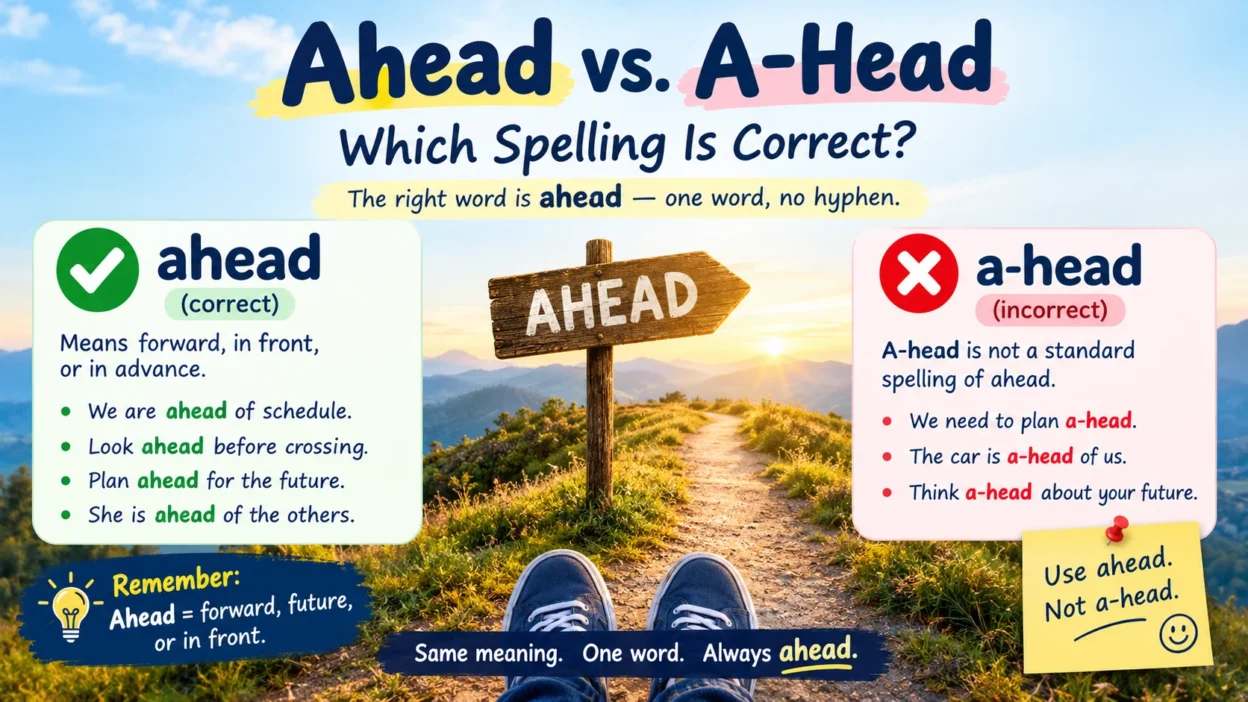
The correct spelling in standard English is “ahead,” written as one word. It means being in front, moving forward, making progress, or being in the future. The form “a-head” is generally incorrect when you want to express these meanings. Although “a” and “head” are separate English words, they should not normally be joined with a hyphen to form this expression.
Understanding the difference between ahead and a-head helps you avoid spelling mistakes in emails, school assignments, professional writing, and everyday conversations. For example, you might say, “We are ahead of schedule,” or “Think ahead before making a decision.” In both sentences, ahead is a single word. This guide explains the meaning of ahead, why people sometimes write a-head, when to use the correct spelling, and how to recognize similar expressions. You will also find practical examples, common mistakes, and answers to frequently asked questions so you can use the word confidently.
Quick Answer
Ahead is the correct standard spelling when you mean forward, in front, or in advance. A-head is not a standard alternative spelling of ahead. Write “look ahead,” “move ahead,” and “ahead of time” as two separate words only where the phrase requires them, with ahead itself always written as one word.
Why Do People Confuse Ahead and A-Head?
People may confuse these forms because ahead sounds as though it contains the separate words “a” and “head.” English also uses hyphens in compound words, which can make a-head seem plausible.
However, the standard English word is ahead. Its spelling does not change when it appears in different expressions.
For example:
- Correct: We need to plan ahead.
- Incorrect: We need to plan a-head.
- Correct: She is ahead of the other runners.
- Incorrect: She is a-head of the other runners.
The key is to remember that ahead is a complete word, not a combination that requires a hyphen.
1. What Does Ahead Mean?
Ahead is an adverb that commonly refers to a position in front, movement forward, progress, or something happening earlier than another event. It can also appear in expressions that describe planning for the future.
Common meanings of Ahead
1. In front of someone or something
- The leading car is ahead of us.
- Walk ahead, and I will follow you.
2. Further forward
- The road ahead is narrow.
- There is a long journey ahead.
3. In advance or before a particular time
- We booked our tickets ahead of time.
- Please prepare the documents ahead of the meeting.
4. Making progress or having an advantage
- Our team is two points ahead.
- She is ahead in her studies.
Example Sentences with Ahead
- We are ahead of schedule.
- Look ahead before crossing the road.
- The future looks bright, with exciting opportunities ahead.
- He planned ahead to avoid unnecessary stress.
2. What Does A-Head Mean?
A-head is not the standard spelling of the ordinary English word ahead. In normal writing, adding a hyphen between “a” and “head” is unnecessary and considered a spelling error when you mean forward, in advance, or in front.
The expression may occasionally appear as a deliberate stylistic name, a brand, a title, or a specialized label. In those cases, its spelling depends on the specific name or context.
Examples of Incorrect Usage
- Incorrect: We arrived a-head of time.
- Correct: We arrived ahead of time.
- Incorrect: Think a-head about your future.
- Correct: Think ahead about your future.
- Incorrect: The blue car is a-head of the red car.
- Correct: The blue car is ahead of the red car.
Unless you are reproducing a specific name or title, use ahead.
3. Ahead vs. A-Head: Comparison Table
| Feature | Ahead | A-head |
|---|---|---|
| Standard spelling | Correct | Generally incorrect |
| Word form | One word | Hyphenated form |
| Meaning | Forward, in front, or in advance | No standard equivalent meaning |
| Everyday writing | Recommended | Avoid |
| Example | Plan ahead | Plan a-head |
| Formal writing | Correct | Incorrect for the intended meaning |
4. When Should You Use Each Form?
Use Ahead in Standard English
Choose ahead whenever you want to describe position, progress, or the future.
Examples:
- We are moving ahead with the project.
- The finish line is just ahead.
- She arrived ten minutes ahead of me.
- There are difficult decisions ahead.
Use A-Head Only When It Is Part of a Specific Name
A-head may appear in a deliberately created name, product label, headline, or other specialized context. If you encounter it in such a setting, check the original source to confirm its intended spelling.
Do not use a-head as a substitute for ahead in ordinary sentences.
5. Examples of Ahead in Everyday English
Here are 12 examples showing how to use ahead correctly.
- Travel: The airport is two miles ahead.
- Planning: We should plan ahead for the holidays.
- Work: The team is ahead of schedule.
- Education: Maria is ahead in her mathematics class.
- Sports: Our team is three points ahead.
- Time: Please arrive ahead of time.
- Driving: Look ahead while driving.
- Career: He is thinking ahead about his career.
- Progress: The company is moving ahead with its plans.
- Conversation: There are better days ahead.
- Preparation: Prepare everything ahead of the presentation.
- Competition: The leading runner is far ahead of the others.
Notice that ahead remains one word in every example.
6. Common Mistakes to Avoid
Even confident English speakers sometimes make spelling mistakes with familiar words. Watch out for these errors.
Mistake 1: Adding an unnecessary hyphen
- Incorrect: We must look a-head.
- Correct: We must look ahead.
Mistake 2: Separating the word
- Incorrect: We need to move a head.
- Correct: We need to move ahead.
The phrase “a head” can be correct when referring to a person’s or animal’s head, but it does not mean forward.
For example, “The statue has a head” is correct because a is an article and head is a noun.
Mistake 3: Confusing ahead with in front
- Correct: The bus is ahead of us.
- Also correct: The bus is in front of us.
Both expressions can describe position, but their grammar differs.
Mistake 4: Writing ahead of time incorrectly
- Incorrect: We completed the task a-head of time.
- Correct: We completed the task ahead of time.
7. Memory Trick: How to Remember Ahead
Use this simple memory trick:
Ahead = forward, future, or in front.
Whenever you want to express one of these ideas, write ahead as a single word.
Remember these three common expressions:
- Look ahead: Think about what is coming.
- Move ahead: Continue or make progress.
- Ahead of time: Before the expected time.
You do not need a hyphen in any of these expressions.
8. American vs. British English
There is no spelling difference between American and British English for the ordinary word ahead.
| English variety | Correct spelling | Example |
|---|---|---|
| American English | Ahead | We are ahead of schedule. |
| British English | Ahead | We are ahead of schedule. |
| Australian English | Ahead | Plan ahead for the trip. |
| Canadian English | Ahead | The road ahead is clear. |
The standard spelling is the same across these varieties. A-head is not an accepted regional alternative for the usual meaning of ahead.
9. Similar Words and Expressions
Learning related expressions can help you understand how ahead is used.
- Forward: Toward the front or onward. Example: Move forward carefully.
- In advance: Before a particular event or time. Example: Book your tickets in advance.
- Previously: At an earlier time. Example: I had previously visited the city.
- In front: At or toward the forward position. Example: The car is in front of the house.
- Progress: Movement toward a goal. Example: We are making progress.
- Beforehand: Before a particular event. Example: Please let me know beforehand.
- Up ahead: In a place farther along. Example: There is a gas station up ahead.
These expressions are related to some meanings of ahead, but they are not interchangeable in every sentence.
10. Frequently Asked Questions
Is ahead one word or two?
Ahead is one word. Write it without a space or hyphen when referring to a forward position, progress, or the future.
Is a-head ever correct?
A-head is not the standard spelling of ahead. It may appear in a specific name, title, or stylized expression, but ordinary English writing uses ahead.
Is ahead of time correct?
Yes. Ahead of time is a common expression meaning before the expected or scheduled time.
Example: We finished the assignment ahead of time.
What is the difference between ahead and a head?
Ahead is an adverb meaning forward, in front, or in advance. A head consists of an article and a noun, referring to a person’s or animal’s head.
Example: “The runner is ahead” versus “The doll has a head.”
Is ahead correct in formal writing?
Yes. Ahead is standard in formal, academic, professional, and informal English.
Example: The department is ahead of its annual targets.
Does British English use a-head?
No, not as a standard alternative to ahead. British English uses ahead, just as American English does.
What are some common phrases with ahead?
Common expressions include look ahead, move ahead, go ahead, think ahead, ahead of schedule, ahead of time, and up ahead.
Remember This
- Ahead is the correct standard spelling.
- A-head is generally incorrect when used to mean forward or in advance.
- Use ahead in formal writing, casual conversation, emails, and academic work.
- Both American and British English use ahead.
- Use “a head” only when you mean a head as a noun, such as in “The statue has a head.”
Conclusion
The difference between ahead and a-head is straightforward: ahead is the correct word in standard English, while a-head is not a standard alternative spelling. Ahead describes something in front, movement forward, progress, or an event that occurs in advance. It appears in common expressions such as “look ahead,” “move ahead,” and “ahead of time.”
To avoid mistakes, remember to write ahead as one word whenever you express these meanings. if you are writing a school assignment, preparing a professional email, or having an everyday conversation, using the correct spelling will make your English clearer and more natural.

David Henry is a language enthusiast and content writer specializing in synonyms, vocabulary, and word meanings. He creates clear, engaging resources that help readers improve their writing, communication, and English skills.