Choosing between “leave it as it is” and “leave it as-is” can be confusing because both expressions communicate the idea of keeping something unchanged. The difference is mainly in their grammatical structure, punctuation, and how they fit into a sentence. Understanding this distinction helps you write more clearly in emails, conversations, academic assignments, and professional documents.
The phrase “leave it as it is” is a natural, widely accepted expression that means not to change something from its current condition. “Leave it as-is” communicates essentially the same meaning, but as-is is a compound expression commonly used to describe something in its existing state, often without repairs, improvements, or modifications. Both forms are understandable and useful in modern English. However, choosing the right one depends on your sentence structure and writing style. This guide explains their meanings, grammatical differences, correct usage, and practical examples so you can confidently decide which expression to use.
Quick Answer
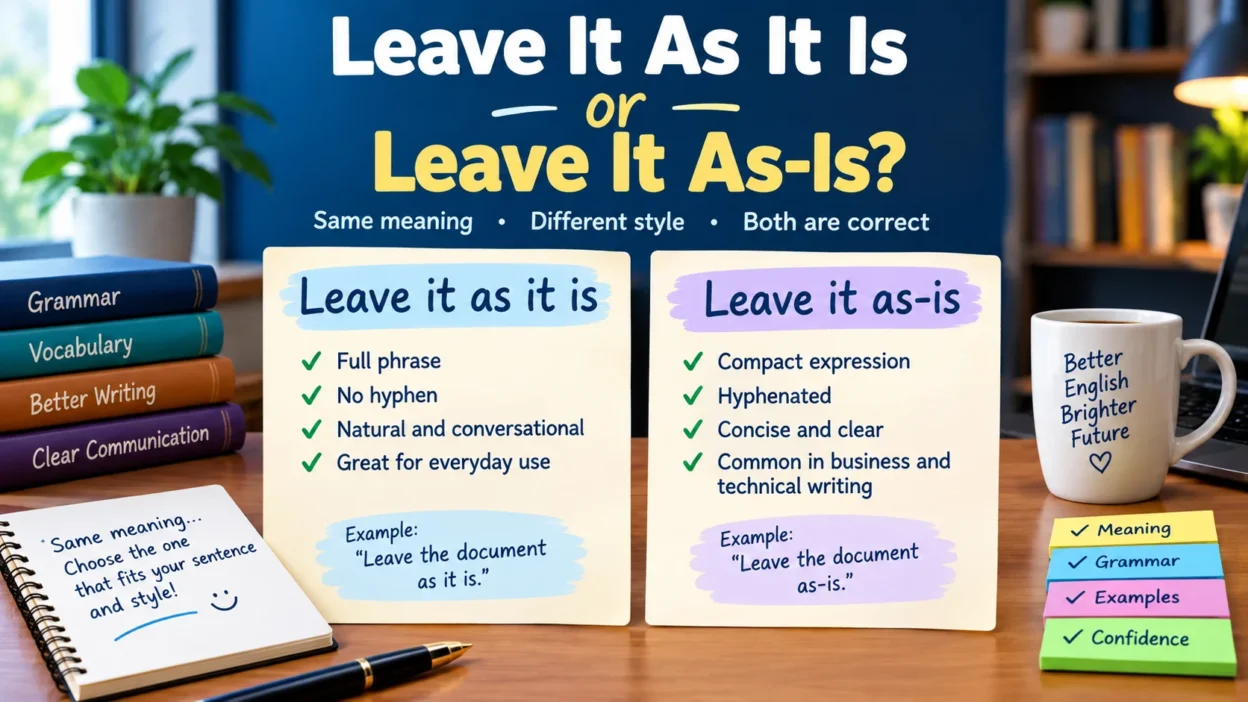
“Leave it as it is” and “leave it as-is” are both acceptable expressions meaning to keep something unchanged. Use “leave it as it is” for a natural, conversational sentence, and use “leave it as-is” when treating as-is as a compact expression meaning in its current condition. In formal writing, the first option is often the simplest choice.
Why Do People Confuse “Leave It As It Is” and “Leave It As-Is”?
People confuse these expressions because they share nearly identical meanings. Both tell someone not to alter, modify, repair, or replace something.
The confusion usually comes from three factors:
- Similar meanings: Both expressions communicate that something should remain unchanged.
- Different structures: “As it is” is a phrase containing the pronoun it, while as-is functions as a compound expression.
- Hyphenation: Writers are often unsure if as is requires a hyphen.
The key is to understand how each expression works in a sentence rather than assuming that one is always correct and the other is always incorrect.
1. Leave It As It Is: Meaning and Usage
“Leave it as it is” is a correct and natural English expression that means to keep something in its present condition without making changes.
It is widely used in everyday conversation, instructions, discussions, and professional communication.
When should you use “leave it as it is”?
Use this expression when you want someone to stop making changes or preserve the current state of something.
Examples:
- Leave the painting as it is.
- I think we should leave the document as it is.
- The room looks good, so leave it as it is.
- Please leave the original design as it is.
Why is “as it is” correct?
The expression uses as to convey the existing manner or condition, while it is refers to the thing’s present state.
For example:
“Your essay is clear and well-organized. Leave it as it is.”
This means the essay is already satisfactory and does not need further changes.
The phrase can also be used when something is imperfect but should remain unchanged for a particular reason.
Example: “The old building has some flaws, but the owners decided to leave it as it is.”
2. Leave It As-Is: Meaning and Usage
“Leave it as-is” is also correct. It means to leave something in its current condition without altering it.
The expression as-is is especially common in business, technology, editing, product descriptions, and discussions about the condition of an item.
When should you use “leave it as-is”?
Use this form when you want to emphasize that something should remain in its existing state.
Examples:
- Leave the file as-is.
- The software configuration should remain as-is.
- We decided to sell the property as-is.
- Please leave the settings as-is.
Why is “as-is” hyphenated?
The hyphen is commonly used when as-is functions as a compound modifier or an established expression describing an existing condition.
For example:
“The company sold the equipment in as-is condition.”
Here, as-is describes the condition of the equipment.
In the instruction “Leave the equipment as-is,” the hyphenated form is also widely used, especially in business and technical writing. Some style guides and writers prefer “leave it as is” without a hyphen when the expression is used adverbially.
Therefore, the hyphen is often a matter of grammatical function and style, not a difference in the underlying meaning.
Comparison Table: Leave It As It Is vs. Leave It As-Is
| Feature | Leave it as it is | Leave it as-is |
|---|---|---|
| Meaning | Keep something unchanged | Keep something unchanged |
| Grammar | Phrase containing “it is” | Compact compound expression |
| Hyphen | Not needed | Commonly used |
| Tone | Natural and conversational | Concise and sometimes technical |
| Everyday conversation | Very common | Also acceptable |
| Business writing | Appropriate | Especially useful |
| Formal writing | Clear and straightforward | Appropriate when consistent with the chosen style |
| Example | Leave the picture as it is. | Leave the picture as-is. |
Both expressions are correct. Choose the one that sounds most natural in your sentence and follow your preferred style guide consistently.
When to Use Each Expression
Use “leave it as it is” for everyday communication
This version works especially well when speaking naturally or giving straightforward instructions.
Examples:
- Leave my desk as it is.
- The paragraph is fine; leave it as it is.
- I prefer the original version, so leave it as it is.
Use “leave it as-is” for concise instructions
This version is useful when discussing files, settings, products, equipment, or existing conditions.
Examples:
- Leave the database as-is.
- The customer wants the product as-is.
- Keep the original formatting as-is.
Can you use both in the same situation?
Yes. In many contexts, either expression works without changing the intended meaning.
- “Leave the design as it is.”
- “Leave the design as-is.”
Both tell someone not to change the design.
12 Examples of “Leave It As It Is” and “Leave It As-Is”
The following examples demonstrate how both expressions work in everyday and professional contexts.
1. Editing: “The introduction is already clear, so leave it as it is.”
2. Design: “I like the original logo. Please leave it as-is.”
3. Technology: “The application is running correctly, so leave the settings as-is.”
4. Home improvement: “The walls have a vintage appearance, and we want to leave them as they are.”
5. Writing: “Your conclusion is effective. Leave it as it is.”
6. Business: “The buyer agreed to purchase the equipment as-is.”
7. Documents: “Do not change the original formatting; leave the file as-is.”
8. Photography: “The colors look natural, so leave the image as it is.”
9. Software development: “The existing code works properly. Leave it as-is for now.”
10. Personal preference: “I like my room the way it is, so please leave it as it is.”
11. Product sales: “The furniture is being sold as-is, without repairs by the seller.”
12. General instruction: “If you are unsure about the changes, leave everything as it is until we review it.”
These examples show that the expressions can communicate the same basic instruction across a wide range of situations.
Common Mistakes to Avoid
Mistake 1: Assuming “as-is” is always wrong
Incorrect assumption: “Leave it as-is” is grammatically incorrect.
Correction: “Leave it as-is” is an accepted usage, particularly in concise instructions and descriptions of existing conditions.
Mistake 2: Assuming the hyphen is always required
The expression is also written as as is in many contexts.
- “Leave the document as is.”
- “Leave the document as-is.”
Both forms are used. Follow the relevant style guide and maintain consistency.
Mistake 3: Writing “leave it as its”
The word its indicates possession, as in “The dog wagged its tail.”
Correct: “Leave it as it is.”
Mistake 4: Using “leave it as it is” when you mean to preserve something temporarily
The expression does not automatically indicate that the condition is permanent.
For example, “Leave it as it is until tomorrow” clearly describes a temporary instruction.
Mistake 5: Confusing “as-is” with “as it was”
These expressions refer to different time frames.
- “Leave it as it is” refers to its present condition.
- “Leave it as it was” refers to a previous condition.
Example: “Restore the document to its original version, then leave it as it was.”
Memory Trick: How to Remember the Difference
Use this simple rule:
- As it is = a full phrase. Think of “it is” as an explicit reference to the current state.
- As-is = a compact expression. Think of it as a short label for the existing condition.
For example:
“Leave the room as it is” sounds like natural conversation.
“Sell the equipment as-is” sounds concise and suitable for a product or business description.
Remember that both expressions can be correct, so focus on the sentence rather than the hyphen alone.
American vs. British English
There is no major difference in meaning between these expressions in American and British English.
| Context | American English | British English |
|---|---|---|
| Everyday instruction | Leave it as it is. | Leave it as it is. |
| Concise instruction | Leave it as-is. | Leave it as-is. |
| Product condition | Sold as-is. | Sold as is / sold as-is, depending on style |
| Formal writing | Both forms may be used | Both forms may be used |
American and British writers both use these expressions. Differences in hyphenation usually reflect editorial preferences, publication standards, or the grammatical role of the phrase rather than a strict national rule.
Similar Words and Expressions
Several expressions have meanings similar to “leave it as it is” and “leave it as-is.”
| Expression | Meaning | Example |
|---|---|---|
| Leave it unchanged | Make no changes | Leave the original text unchanged. |
| Keep it as it is | Preserve the current state | Keep the arrangement as it is. |
| Leave it alone | Do not interfere with it | Leave the computer alone. |
| Keep it intact | Preserve it without damage | Keep the original document intact. |
| Leave it untouched | Do not handle or modify it | Leave the painting untouched. |
| Keep it the same | Maintain the existing state | Keep the formatting the same. |
| In its current condition | In the state it is in now | The item is sold in its current condition. |
| As things stand | According to the current situation | As things stand, no changes are needed. |
Although these expressions are similar, they are not always interchangeable. For example, “leave it alone” can suggest avoiding interference, while “leave it unchanged” specifically emphasizes making no modifications.
Final Verdict: Which One Should You Use?
Both “leave it as it is” and “leave it as-is” are acceptable English expressions.
Choose “leave it as it is” when you want a natural, straightforward expression suitable for conversation, general writing, and formal communication.
Choose “leave it as-is” when you prefer a shorter expression, especially in technical instructions, business descriptions, and discussions about products or existing conditions.
If you are unsure which form to use, “leave it as it is” is a safe, clear choice for most everyday situations. Remember that as is can also appear without a hyphen, depending on the sentence and style guide.
Frequently Asked Questions (FAQs)
1. Is it “leave it as it is” or “leave it as-is”?
Both are correct. “Leave it as it is” is a full phrase, while “leave it as-is” is a concise alternative. Both mean to keep something in its current condition.
2. Is “leave it as-is” grammatically correct?
Yes. “Leave it as-is” is widely used in modern English, especially in business, technical, and everyday instructions. The hyphenated expression communicates that something should remain unchanged.
3. Should “as is” have a hyphen?
Not always. As-is is commonly hyphenated when used as a compound expression or modifier, but as is is also widely accepted in other grammatical contexts. Follow your preferred style guide.
4. Is “leave it as it is” more formal?
It can be suitable for both formal and informal writing. Its full structure makes it clear and natural, but “leave it as-is” is also acceptable in professional communication.
5. What does “leave it as-is” mean in business?
In business, “leave it as-is” generally means to maintain something in its existing condition without changes. For example, a company might keep a software configuration unchanged or sell a product in its current condition.
6. Can I write “leave it as is” without a hyphen?
Yes. “Leave it as is” is an established and widely used form. if you use the hyphenated or unhyphenated version may depend on the grammatical context and the style guide you follow.
7. What is another way to say “leave it as it is”?
You can say “leave it unchanged,” “keep it the same,” “leave it untouched,” or “keep it in its current condition.” The best alternative depends on the context and if you want to emphasize preservation, lack of interference, or the absence of changes.
Remember This
- “Leave it as it is” is correct and natural.
- “Leave it as-is” is also correct and concise.
- “As is” may be written without a hyphen, depending on its use and the style guide.
- Both expressions generally mean to keep something unchanged.
- When in doubt, use “leave it as it is” for clear, everyday communication.
Conclusion
The choice between “leave it as it is” and “leave it as-is” is mainly a matter of sentence structure, style, and context. Both expressions communicate that something should remain in its current condition. The first is a straightforward phrase that fits naturally into everyday conversation, while the second offers a concise alternative that is especially useful in technical and business contexts.
To write confidently, pay attention to how the expression fits into your sentence and use hyphenation consistently. If you want a simple option that works in almost any situation, choose “leave it as it is.” If you need a shorter expression to describe an existing condition, “leave it as-is” is a useful alternative.

David Henry is a language enthusiast and content writer specializing in synonyms, vocabulary, and word meanings. He creates clear, engaging resources that help readers improve their writing, communication, and English skills.