Have you ever wondered if to use mean or means in a sentence? These two words look almost identical, but they are used differently depending on the subject, tense, and meaning of a sentence. Understanding the difference between mean and means can help you write more clearly and speak English with confidence.
The word mean can describe what someone intends to say, what a word represents, or how someone behaves. It can also refer to an average in mathematics. Means can be the third-person singular form of the verb mean, but it can also be a noun referring to a method, way, or resource. For example, “I mean what I say” is correct, while “She means what she says” uses the singular verb form. Similarly, “Education is a means of success” uses means as a noun. In this guide, you will learn how to use both words correctly, understand their grammatical differences, and avoid common mistakes.
Quick Answer: Mean or Means
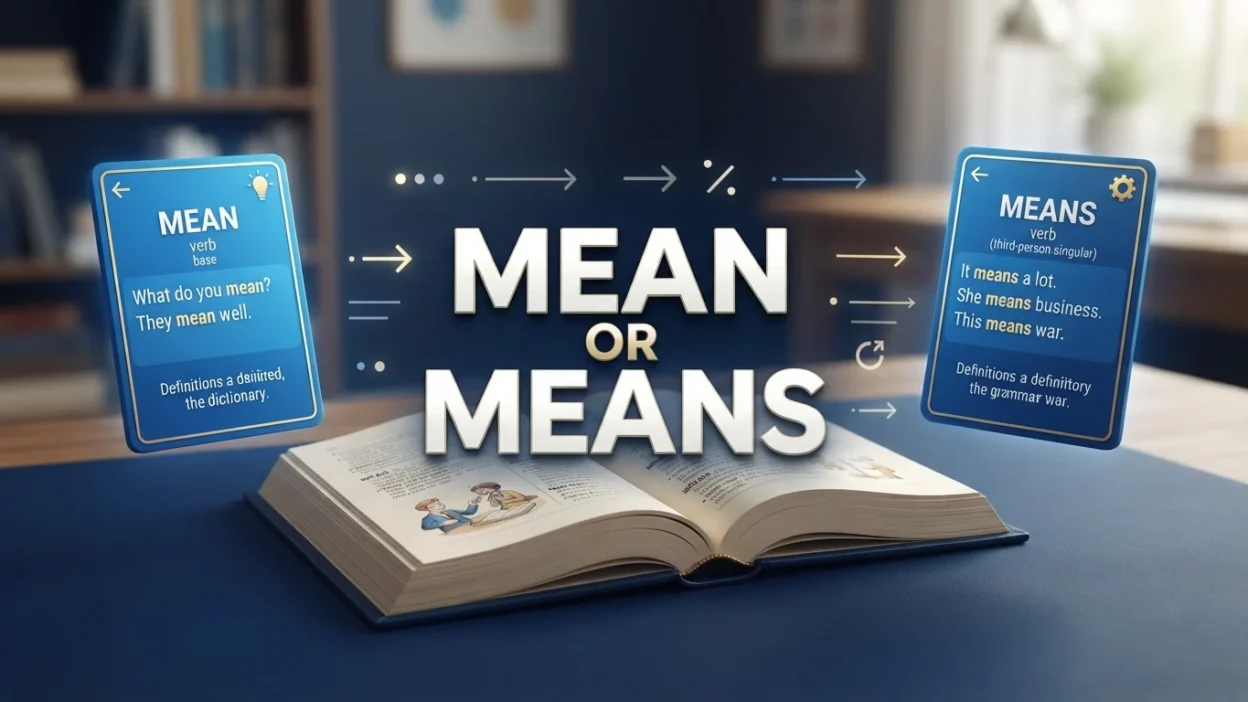
Mean is used with I, you, we, and they in the simple present tense, while means is used with he, she, it, and singular nouns. However, means can also be a noun meaning a method or way of doing something. For example, “I mean it” and “She means it” are both correct.
Why Do People Confuse Mean and Means?
People often confuse mean and means because both words can express the same basic idea, but their grammatical roles differ.
There are three main reasons for this confusion:
- Subject-verb agreement: The verb changes depending on whether the subject is singular or plural.
- Different meanings: Mean can be a verb or adjective, while means can be a verb or noun.
- Similar spelling: The only difference is the letter “s,” which makes it easy to choose the wrong form.
Understanding the subject and the intended meaning will help you select the correct word.
1. Mean: Meaning, Definition, and Usage
Mean is a verb that can express an intention, definition, or result. It can also function as an adjective describing someone who is unkind.
Mean as a Verb
As a verb, mean has several common meanings:
- To intend: To have a particular purpose or plan.
- Example: I mean to call you tomorrow.
- To signify: To represent or express something.
- Example: What does this word mean?
- To indicate: To suggest or show something.
- Example: Dark clouds mean rain is coming.
In the simple present tense, mean is used with I, you, we, and they.
Examples:
- I mean what I say.
- You mean a lot to me.
- We mean no harm.
- They mean well.
Mean as an Adjective
Mean can also describe someone who is unkind, cruel, or unwilling to share.
Examples:
- He is mean to his classmates.
- That was a mean thing to say.
- She is not mean; she is just having a bad day.
Mean in Mathematics
In mathematics, the mean is the average of a set of numbers.
For example, the mean of 4, 6, and 8 is 6.
4+6+83=6\frac{4+6+8}{3}=634+6+8=6
2. Means: Meaning, Definition, and Usage
Means has two common grammatical uses: it can be the third-person singular form of the verb mean, or it can be a noun referring to a method, way, or resource.
Means as a Verb
Means is used with he, she, it, and singular nouns in the simple present tense.
Examples:
- She means what she says.
- He means well.
- This sign means “stop.”
- The word means something different here.
In these sentences, means expresses intention, significance, or meaning.
Means as a Noun
As a noun, means refers to a method, way, or resource used to achieve something.
Examples:
- Education is a means of improving your future.
- The internet is a useful means of communication.
- They found a means of solving the problem.
The noun means has the same form in both singular and plural contexts.
Examples:
- This is a means of communication.
- These are several means of communication.
Means of Living
The phrase means of living refers to the resources or income a person uses to support themselves. A more common expression is means of livelihood.
Example:
– Farming is their main means of livelihood.
Mean vs. Means: Comparison Table
|
Feature
|
Mean
|
Means
|
| — | — | — |
|
Part of speech
|
Verb or adjective; also a mathematical noun
|
Verb or noun
|
|
Verb usage
|
I, you, we, they
|
He, she, it, singular nouns
|
|
Main verb meaning
|
Intend, signify, or indicate
|
Same meaning as mean
|
|
Noun meaning
|
Mathematical average
|
Method, way, or resource
|
|
Example
|
I mean what I say.
|
She means what she says.
|
|
Noun example
|
The mean is 10.
|
Education is a means of success.
|
When to Use Mean or Means
Choosing between mean and means depends on the subject and the role the word plays in the sentence.
Use Mean When:
- The subject is I, you, we, or they in the simple present tense.
- You are using the base form of the verb after to or a modal verb.
- You are describing someone as unkind.
- You are referring to an average in mathematics.
Examples:
- I mean no disrespect.
- They mean well.
- You should mean what you say.
- He can mean what he says.
- That was a mean comment.
- The mean of the numbers is 12.
Use Means When:
- The subject is he, she, it, or a singular noun in the simple present tense.
- You are referring to a method, way, or resource.
Examples:
- She means what she says.
- This word means “happy.”
- A bicycle is a means of transportation.
- Hard work means a lot to him.
12 Examples of Mean and Means in Sentences
Here are 12 practical examples to help you understand how each word works in everyday English.
Examples Using Mean
- I mean what I say. — Expresses a sincere intention.
- What do you mean by that? — Asks someone to explain their words.
- We mean no harm. — Shows that there is no intention to hurt anyone.
- They mean well. — Indicates that someone has good intentions.
- You mean a lot to me. — Expresses affection or importance.
- These numbers have a mean of 15. — Refers to a mathematical average.
Examples Using Means
- She means every word she says. — Shows that she is sincere.
- He means no offense. — Indicates that he does not intend to insult anyone.
- This symbol means danger. — Explains what a symbol represents.
- Education is a means of personal growth. — Describes education as a way to develop.
- The train is a convenient means of transportation. — Refers to a method of travel.
- This means we have to leave early. — Explains the result or implication of something.
Common Mistakes When Using Mean and Means
Even fluent English speakers sometimes make mistakes with these words. Here are some common errors and their corrections.
|
Incorrect
|
Correct
|
Explanation
|
| — | — | — |
|
She mean well.
|
She means well.
|
Use means with she.
|
|
He mean what he says.
|
He means what he says.
|
A singular subject takes means.
|
|
They means no harm.
|
They mean no harm.
|
Use mean with they.
|
|
I means it.
|
I mean it.
|
Use mean with I.
|
|
Education is a mean of success.
|
Education is a means of success.
|
Means is the noun meaning a method.
|
|
What means this word?
|
What does this word mean?
|
Use does + base verb in a question.
|
Mistake 1: Forgetting Subject-Verb Agreement
Incorrect: She mean what she says.
Correct: She means what she says.
Remember that he, she, and it usually take means in the simple present tense.
Mistake 2: Using Means With Plural Subjects
Incorrect: They means well.
Correct: They mean well.
Plural subjects use mean in the simple present tense.
Mistake 3: Confusing the Noun and Verb
Incorrect: A phone is a mean of communication.
Correct: A phone is a means of communication.
When referring to a method or resource, use means.
Memory Trick: How to Remember Mean vs. Means
Use this simple trick:
He, she, it → means. Everyone else → mean.
For the simple present tense:
- I mean.
- You mean.
- He means.
- She means.
- It means.
- We mean.
- They mean.
For the noun, remember that a means is a way of achieving something.
Example: “A dictionary is a means of learning new words.”
Mean vs. Means in American and British English
There is no significant difference between American and British English in the basic grammatical rules for mean and means.
Both varieties use:
- Mean with I, you, we, and they.
- Means with he, she, it, and singular nouns.
- Means as a noun meaning a method, way, or resource.
Examples in both varieties:
- She means what she says.
- We mean no harm.
- Education is a means of success.
The spelling and usage are generally the same in both forms of English.
Similar Words and Related Expressions
Understanding related words can help you express your ideas more precisely.
|
Word
|
Meaning
|
Example
|
| — | — | — |
|
Meaning
|
The idea or message expressed by a word or action
|
What is the meaning of this word?
|
|
Meant
|
Past tense of mean
|
I meant to call you.
|
|
Meaningful
|
Having importance or significance
|
We had a meaningful conversation.
|
|
Intend
|
To plan or aim to do something
|
I intend to finish the work.
|
|
Signify
|
To represent or indicate something
|
A red light signifies danger.
|
|
Method
|
A way of doing something
|
This method works well.
|
|
Average
|
A typical or central value
|
The average score was 80.
|
Frequently Asked Questions (FAQs)
1. Is it mean or means?
Both are correct, but they are used differently. Mean is used with I, you, we, and they in the simple present tense. Means is used with he, she, it, and singular nouns. Means can also be a noun referring to a method or resource.
2. Is it “she mean” or “she means”?
The correct form is “she means.” In the simple present tense, singular third-person subjects such as he, she, and it take the verb means.
Example: She means what she says.
3. What is the difference between mean and means in grammar?
Mean is the base form of the verb, while means is its third-person singular present form. Means can also function as a noun meaning a method, way, or resource.
4. Is “means” singular or plural?
Means can be singular or plural when used as a noun. For example, “a means of communication” is singular, while “several means of communication” is plural. The form of the word stays the same.
5. Is it “it mean” or “it means”?
The correct form is “it means.” The pronoun it takes the third-person singular verb form in the simple present tense.
Example: It means we should leave now.
6. What does “means” mean in a sentence?
Means can mean “signifies” or “indicates” when used as a verb. As a noun, it can refer to a method, way, or resource.
Example: “This means we are ready” uses means as a verb.
7. Is “mean” always a verb?
No. Mean can be a verb, an adjective describing someone as unkind, or a noun referring to a mathematical average.
Examples: “I mean it” (verb), “a mean person” (adjective), and “the mean is 5” (noun).
Remember This
- Mean: Use it with I, you, we, and they in the simple present tense.
- Means: Use it with he, she, it, and singular nouns in the simple present tense.
- Means as a noun: It refers to a method, way, or resource.
- Mean as an adjective: It can describe someone who is unkind.
- Mean as a noun: It can refer to a mathematical average.
Conclusion
The difference between mean and means mainly depends on grammar and context. Mean is the base form of the verb, while means is used with singular third-person subjects in the simple present tense. Both words can also have different meanings depending on how they are used.
Remember that means can also function as a noun meaning a method or resource, while mean can describe unkind behavior or a mathematical average. By paying attention to the subject and the meaning of the sentence, you can use both words correctly and communicate more confidently in English.

David Henry is a language enthusiast and content writer specializing in synonyms, vocabulary, and word meanings. He creates clear, engaging resources that help readers improve their writing, communication, and English skills.