
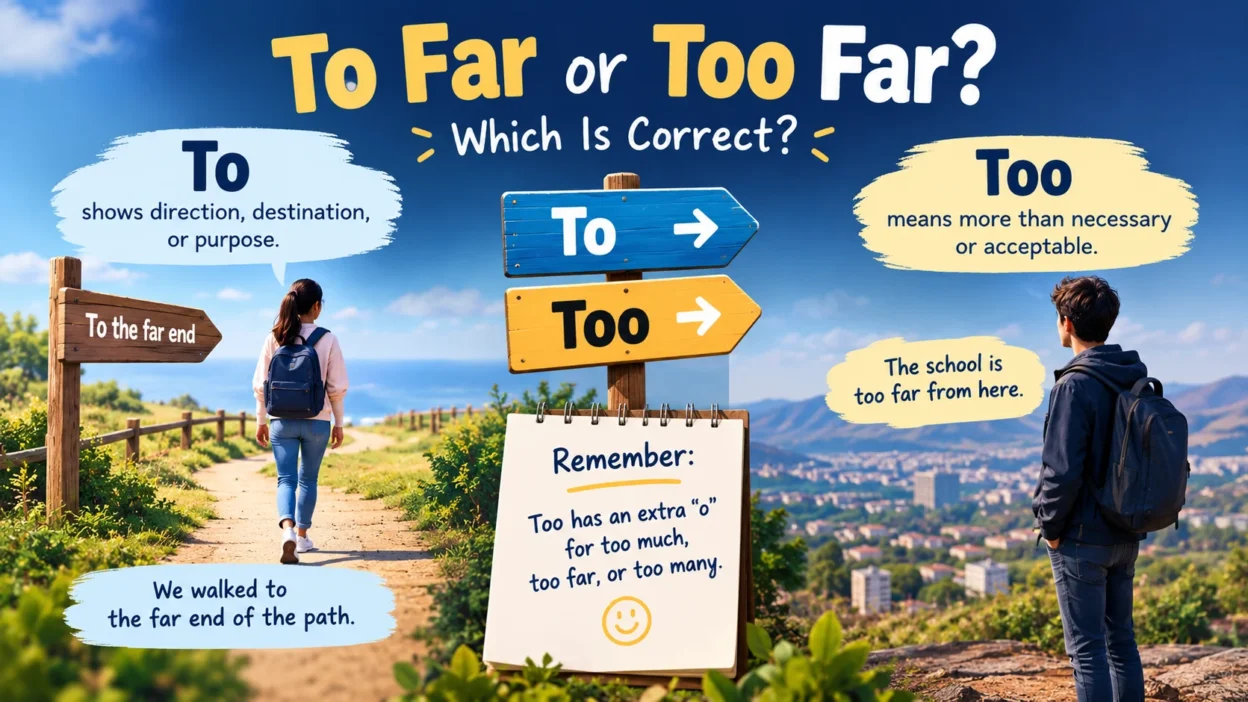
Have you ever wondered if to write “to far” or “too far”? These two phrases sound exactly the same, but only one is correct when you want to describe something that is beyond a reasonable distance, limit, or degree. Understanding the difference between “to” and “too” can help you avoid common spelling and grammar mistakes in everyday writing.
The correct phrase is “too far” when you mean that something is at an excessive distance or has gone beyond an acceptable limit. For example, “The school is too far from my house” means the school is farther away than is convenient. On the other hand, “to far” is generally incorrect when expressing this meaning. However, “to” can appear before the word “far” in a sentence when the words serve separate grammatical purposes. In this guide, you will learn the meanings of both words, discover when to use each one, and explore practical examples to help you write with confidence.
Quick Answer: To Far or Too Far?
“Too far” is the correct phrase when describing excessive distance, degree, or limits. The word “too” means “more than necessary” or “more than acceptable.” “To far” is generally a spelling mistake in this context. For example, “You went too far” means someone crossed a reasonable or acceptable boundary.
Why Do People Confuse “To Far” and “Too Far”?
People often confuse “to far” and “too far” because the words “to” and “too” sound alike in spoken English.
However, they have different meanings and grammatical functions.
- To: A preposition used to show direction, destination, or a relationship. It can also be part of an infinitive, as in “to walk.”
- Too: An adverb meaning “also” or “more than necessary.”
When talking about excessive distance or crossing a limit, “too far” is the correct expression.
What Does “To” Mean?
The word “to” is a preposition or part of an infinitive verb. It commonly indicates direction, destination, purpose, or a relationship between words.
Common Uses of “To”
- Direction: She walked to the park.
- Destination: We are going to London.
- Purpose: He came to help me.
- Recipient: I gave the book to my friend.
- Time: The store is open from Monday to Friday.
Examples of “To” in Sentences
- I am going to school.
- She sent a letter to her teacher.
- We decided to leave early.
- He walked to the far end of the street.
Notice that in the last example, “to” shows direction, while “far” describes the distance or location.
What Does “Too” Mean?
The word “too” is an adverb with two main meanings: “also” and “more than necessary or acceptable.”
When used with “far,” it expresses excessive distance or a limit that has been exceeded.
Common Uses of “Too”
- Excessive degree: The coffee is too hot.
- Excessive distance: The airport is too far away.
- Excessive amount: There is too much noise.
- Addition: I want to come too.
Examples of “Too” in Sentences
- This bag is too heavy to carry.
- The restaurant is too far from here.
- You are speaking too loudly.
- She wants to join us too.
Comparison Table: To vs Too
|
Feature
|
To
|
Too
|
| — | — | — |
|
Part of speech
|
Preposition or infinitive marker
|
Adverb
|
|
Main meaning
|
Direction, destination, or purpose
|
Also or excessively
|
|
Used with “far”
|
Shows direction in phrases like “to the far end”
|
Means excessively far
|
|
Correct example
|
We drove to the far side.
|
The drive is too far.
|
|
Common mistake
|
Writing “to far” for excessive distance
|
Using “too” when direction is intended
|
When Should You Use “To Far” or “Too Far”?
The correct choice depends on what you want to express.
When to Use “Too Far”
Use “too far” when something is farther away than is convenient, acceptable, or reasonable.
Examples:
- The hospital is too far from my home.
- You have taken this joke too far.
- The car is parked too far from the entrance.
- The price has gone too far beyond my budget.
When to Use “To” Before “Far”
Use “to” when it introduces a destination or direction and “far” describes a place or distance.
Examples:
- We walked to the far end of the garden.
- She drove to a faraway town.
- He ran to the far side of the field.
In these examples, “to” is not modifying “far.” It is connecting the action to a destination.
12 Examples of “Too Far” and “To” in Sentences
Here are 12 examples showing how to use these words correctly.
Examples of “Too Far”
- The grocery store is too far from my house. The distance is inconvenient.
- You have gone too far with that joke. The joke has crossed a boundary.
- The school is too far to walk to. Walking there would be difficult because of the distance.
- The bus stop is too far away. The bus stop is not nearby.
- The price is too far above my budget. The price exceeds what I can afford.
- The ball rolled too far down the hill. It traveled farther than intended.
- You are standing too far from the camera. You are farther away than needed.
Examples of “To” Used with “Far”
- We walked to the far end of the beach. “To” shows the destination.
- She drove to the far side of the parking lot. “To” indicates direction.
- He ran to the far corner of the room. The phrase identifies where he ran.
- They traveled to a faraway village. “To” introduces the destination.
- I moved to the far end of the line. “To” shows the direction of movement.
Common Mistakes When Using “To Far” and “Too Far”
Writers sometimes use “to” instead of “too” because the two words sound alike. Here are some mistakes to avoid.
Mistake 1: Using “To Far” for Excessive Distance
❌ The airport is to far from here.
✅ The airport is too far from here.
Why? “Too” means the distance is greater than what is convenient or acceptable.
Mistake 2: Using “To” Instead of “Too” for Excessive Behavior
❌ You went to far with that comment.
✅ You went too far with that comment.
Why? “Too far” means someone has crossed a boundary.
Mistake 3: Confusing “Too Far” with “So Far”
❌ I have lived here too far this year.
✅ I have lived here so far this year.
Why? “So far” means “until now” or “up to this point.” “Too far” expresses excessive distance or degree.
Mistake 4: Using “Too” for Direction
❌ We walked too the far end of the road.
✅ We walked to the far end of the road.
Why? “To” indicates the destination.
Memory Trick: How to Remember “To Far” vs “Too Far”
Use this simple trick to remember the difference:
- Too has an extra “o,” just like “too much” and “too many.” Think of the extra “o” as something extra or excessive.
- To shows direction. Think of going “to” a place, such as going to school or walking to the park.
Remember: If you mean “excessively far,” use “too far.”
American vs British English: Is There a Difference?
There is no difference between American and British English in the use of “to far” and “too far.”
Both varieties use “too far” to describe excessive distance or an exceeded limit.
Examples:
- American English: The store is too far away.
- British English: The shop is too far away.
The vocabulary may differ slightly, such as “store” and “shop,” but the spelling and grammatical rules for “too far” remain the same.
Similar Words and Expressions
Several expressions are related to “too far” but have different meanings.
|
Expression
|
Meaning
|
Example
|
| — | — | — |
|
Too far
|
Beyond a reasonable distance or limit
|
The station is too far away.
|
|
So far
|
Until now or up to a point
|
So far, everything is fine.
|
|
Very far
|
A great distance
|
The airport is very far from here.
|
|
Far too
|
Excessively or much more than acceptable
|
The room is far too small.
|
|
Too distant
|
Excessively far away
|
The village is too distant to visit today.
|
|
Far away
|
At a great distance
|
My hometown is far away.
|
Final Verdict: To Far or Too Far?
“Too far” is the correct expression when you mean excessive distance or crossing a limit. “To far” is generally incorrect when used with that meaning.
Use “to” when showing direction or introducing a destination, as in “We walked to the far end of the road.”
Use “too” when something is more than necessary, reasonable, or acceptable, as in “The road is too far to walk.”
Frequently Asked Questions (FAQs)
1. Is “to far” correct or “too far”?
“Too far” is correct when describing excessive distance or a limit that has been exceeded. “To far” is generally a spelling mistake in this context.
2. Why is “too far” correct?
“Too” is an adverb that means “more than necessary” or “more than acceptable.” When paired with “far,” it describes a distance or degree that is excessive.
3. Is it “you went to far” or “you went too far”?
The correct phrase is “you went too far.” It means someone has crossed a reasonable or acceptable boundary.
4. What is the difference between “too far” and “so far”?
“Too far” describes excessive distance or degree, while “so far” means “until now” or “up to this point.”
Example: “The store is too far away.” / “So far, the project is going well.”
5. Can “to” and “far” appear together correctly?
Yes. For example, “We walked to the far end of the street.” Here, “to” indicates direction, and “far” describes the location.
6. Is “too far away” grammatically correct?
Yes. “Too far away” is correct and means that something is at an excessive distance.
Example: “The restaurant is too far away for us to walk.”
7. Is “far too” the same as “too far”?
No. “Far too” means “excessively” or “much more than acceptable,” while “too far” usually describes excessive distance or a crossed limit.
Example: “The meal is far too expensive.” / “The restaurant is too far away.”
Remember This
- Too far = excessively far or beyond a reasonable limit.
- To = direction, destination, or part of an infinitive.
- So far = until now or up to this point.
If you are talking about excessive distance or crossing a boundary, always use “too far.”
Conclusion
Understanding the difference between “to far” and “too far” is simple once you remember that “to” indicates direction or purpose, while “too” expresses excess or addition. When describing something that is farther away than is convenient or acceptable, “too far” is the correct expression.
With the examples, comparison table, and memory trick in this guide, you can confidently use “too far” in everyday conversations, school assignments, emails, and professional writing. Remember that “to the far end” is also correct when “to” introduces a destination.

David Henry is a language enthusiast and content writer specializing in synonyms, vocabulary, and word meanings. He creates clear, engaging resources that help readers improve their writing, communication, and English skills.