Choosing between “I” and “me” can be confusing, especially when talking about yourself and another person. Both words refer to the person speaking, but they have different roles in a sentence. Knowing when to use each one will help you speak and write English more clearly.
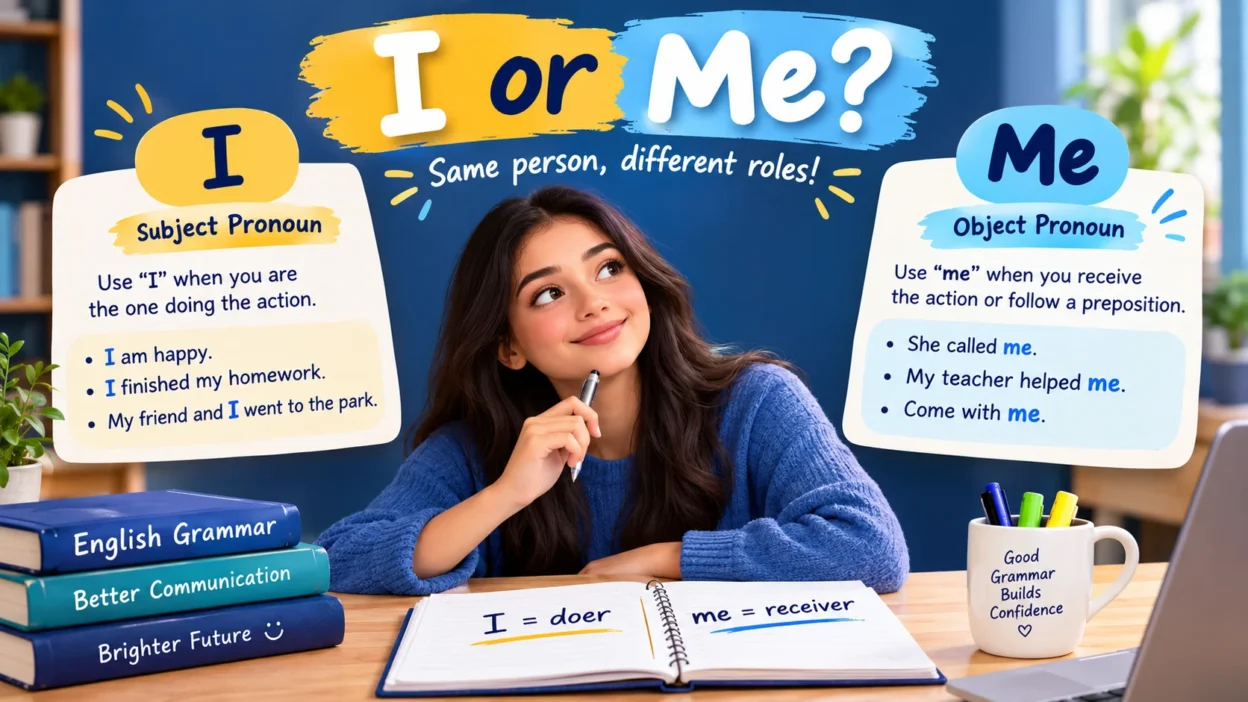
The main difference between “I” and “me” is their grammatical function. “I” is a subject pronoun, which means it usually performs the action in a sentence. “Me” is an object pronoun, which means it usually receives the action or follows a preposition. For example, you say “I called my friend,” but “My friend called me.”
This guide explains the difference between “I” and “me” in simple English. You will learn the rules, explore everyday examples, understand common mistakes, and discover easy ways to choose the correct pronoun in conversations, schoolwork, and formal writing.
Quick Answer: Should I Use “I” or “Me”?
Use “I” when you are the subject performing an action, as in “I finished my homework.” Use “me” when you are the object receiving an action or following a preposition, as in “She helped me” or “Come with me.” The correct choice depends on the pronoun’s role in the sentence.
Why Do People Confuse “I” and “Me”?
People often confuse “I” and “me” because both pronouns refer to the person speaking. The confusion becomes more common when another person is included in the sentence.
For example:
- Correct: My brother and I went shopping.
- Correct: My brother came shopping with my sister and me.
In everyday conversation, some people use “I” in situations where “me” is grammatically correct because they think “I” sounds more formal or polite.
However, choosing the correct pronoun depends on grammar, not politeness.
What Does “I” Mean?
“I” is a first-person singular subject pronoun. It refers to the person speaking and is used when that person performs an action or serves as the subject of a sentence.
When Should You Use “I”?
Use “I” when you are the person doing something or when you are the subject of a sentence.
Examples:
- I love reading books.
- I am learning English.
- I went to school yesterday.
- I feel happy today.
- My friend and I are studying together.
In each sentence, “I” identifies the person who performs the action or experiences the stated condition.
What Does “Me” Mean?
“Me” is a first-person singular object pronoun. It refers to the person speaking when that person receives an action or follows a preposition.
When Should You Use “Me”?
Use “me” when someone does something to you, when you receive an action, or when a preposition introduces the pronoun.
Examples:
- She called me yesterday.
- My teacher helped me.
- He gave me a gift.
- Please sit beside me.
- They invited my brother and me.
In these sentences, “me” is the object of a verb or preposition.
I vs Me: Comparison Table
|
Feature
|
I
|
Me
|
| — | — | — |
|
Grammatical role
|
Subject pronoun
|
Object pronoun
|
|
Main function
|
Performs the action
|
Receives the action or follows a preposition
|
|
Common position
|
Before the verb as the subject
|
After a verb or preposition
|
|
Example
|
I called her.
|
She called me.
|
|
With another person
|
My friend and I
|
My friend and me
|
|
Common use
|
“I am ready.”
|
“Tell me the truth.”
|
When Should You Use I or Me?
Use “I” as the Subject
Choose “I” when you are doing the action.
- I wrote the letter.
- My sister and I watched a movie.
- I enjoy playing football.
Use “Me” as the Object
Choose “me” when the action is directed toward you.
- She invited me to dinner.
- My parents supported me.
- The coach selected my friend and me.
Use “Me” After a Preposition
Prepositions such as to, for, with, between, and from are followed by object pronouns.
Examples:
- This gift is for me.
- Come with me.
- She spoke to me.
- The secret is between you and me.
- He received a message from me.
What About “I” or “Me” With Another Person?
When you mention yourself with someone else, the correct pronoun still depends on its grammatical role.
- Subject: My cousin and I went to the park.
- Object: The teacher praised my cousin and me.
A useful trick is to remove the other person and check whether the sentence still sounds grammatically correct.
12 Examples of I vs Me in Everyday English
Here are 12 examples showing how to use “I” and “me” correctly.
|
No.
|
Correct sentence
|
Why?
|
| — | — | — |
|
1
|
I am tired.
|
“I” is the subject.
|
|
2
|
She called me.
|
“Me” is the object.
|
|
3
|
I like music.
|
“I” performs the action.
|
|
4
|
He helped me.
|
“Me” receives the action.
|
|
5
|
My friend and I went outside.
|
“I” is part of the subject.
|
|
6
|
She invited my friend and me.
|
“Me” is part of the object.
|
|
7
|
This letter is for me.
|
“Me” follows “for.”
|
|
8
|
I gave him a book.
|
“I” is the subject.
|
|
9
|
They waited for me.
|
“Me” follows “for.”
|
|
10
|
I will call you later.
|
“I” performs the action.
|
|
11
|
The manager spoke to me.
|
“Me” follows “to.”
|
|
12
|
My brother and I are ready.
|
“I” is part of the subject.
|
Common Mistakes When Using I and Me
Here are some frequent errors and their corrections.
Mistake 1: Using “Me” as the Subject
❌ Me and Sarah went to the library.
✅ Sarah and I went to the library.
Why? “I” is required because the pronoun is part of the subject.
Mistake 2: Using “I” as the Object
❌ The teacher called Sarah and I.
✅ The teacher called Sarah and me.
Why? “Me” is the object of the verb “called.”
Mistake 3: Using “I” After a Preposition
❌ This gift is for my brother and I.
✅ This gift is for my brother and me.
Why? Prepositions such as “for” take object pronouns.
Mistake 4: Thinking “I” Is Always More Formal
❌ The invitation was sent to my sister and I.
✅ The invitation was sent to my sister and me.
Why? Formal writing still follows standard subject-object grammar.
Mistake 5: Forgetting to Check the Pronoun’s Role
❌ Me completed the assignment.
✅ I completed the assignment.
Why? The person completing the assignment is the subject.
Easy Memory Trick: How to Remember I vs Me
Use this simple trick:
- I = Doer: Use “I” when you perform the action.
- Me = Receiver: Use “me” when you receive the action or follow a preposition.
The Remove-the-Other-Person Trick
When you are unsure whether to use “I” or “me” with another person, remove the other person from the sentence.
Example 1:
“My friend and I went shopping.”
Remove “my friend”:
“I went shopping.” ✅
Example 2:
“The teacher praised my friend and me.”
Remove “my friend”:
“The teacher praised me.” ✅
This trick helps you identify the correct pronoun in many everyday sentences.
I vs Me in American and British English
The basic grammatical rules for “I” and “me” are the same in American and British English.
|
Usage
|
American English
|
British English
|
| — | — | — |
|
Subject pronoun
|
I went home.
|
I went home.
|
|
Object pronoun
|
She called me.
|
She called me.
|
|
With another person
|
John and I arrived.
|
John and I arrived.
|
|
After a preposition
|
Come with me.
|
Come with me.
|
Both varieties use “I” as a subject pronoun and “me” as an object pronoun. Informal speech may vary, but the standard grammatical rules remain consistent.
Similar Words Related to I and Me
Understanding related pronouns can make English grammar easier.
|
Pronoun
|
Grammatical role
|
Example
|
| — | — | — |
|
I
|
Subject
|
I am happy.
|
|
Me
|
Object
|
She called me.
|
|
My
|
Possessive determiner
|
My book is new.
|
|
Mine
|
Possessive pronoun
|
This book is mine.
|
|
Myself
|
Reflexive or emphatic pronoun
|
I taught myself.
|
|
We
|
Plural subject pronoun
|
We are ready.
|
|
Us
|
Plural object pronoun
|
She helped us.
|
These pronouns refer to different grammatical roles and should not be used interchangeably.
Final Verdict: I or Me?
The difference between “I” and “me” is simple: “I” is a subject pronoun, while “me” is an object pronoun.
Use “I” when you perform an action, as in “I wrote a letter.” Use “me” when you receive an action or follow a preposition, as in “She helped me” or “Come with me.”
When mentioning yourself with another person, identify the grammatical role first. This will help you choose the correct pronoun naturally and confidently.
Frequently Asked Questions (FAQs)
1. Is it “I and John” or “John and I”?
“John and I” is correct when the two people are the subject of a sentence.
Example: “John and I went to school.”
2. Is it “me and John” or “John and me”?
“John and me” is correct when the two people are the object of a verb or preposition.
Example: “She invited John and me.”
In informal conversation, you may hear “me and John,” but it is not the usual choice in formal writing.
3. Should I say “between you and I” or “between you and me”?
The standard grammatical form is “between you and me” because “between” is a preposition and requires an object pronoun.
4. Is “Me and my friend went to school” correct?
In standard English, the preferred sentence is “My friend and I went to school.” The pronoun “I” is needed because it is part of the subject.
5. Why do people say “my friend and I” instead of “me and my friend”?
“My friend and I” is commonly used as a subject because “I” is the correct subject pronoun. Mentioning the other person first is also a common courtesy in English.
6. Can “I” and “me” be used in the same sentence?
Yes. They can appear together when they have different grammatical roles.
Example: “I told my teacher that she could call me later.”
Here, “I” is the subject, while “me” is the object.
7. Is “me” ever correct at the beginning of a sentence?
Yes, in some informal expressions or when “me” is used as an object in a short response.
Example: “Me too!”
However, in a standard sentence where the speaker performs an action, use “I.”
Remember This
- I = Subject: I love English.
- Me = Object: She helped me.
- After a preposition: Use “me,” as in “with me.”
- With another person: My friend and I went out; she invited my friend and me.
The key is to identify whether you are performing the action or receiving it.
Conclusion
Understanding the difference between “I” and “me” is an important step toward using English correctly. Although both pronouns refer to the speaker, “I” functions as a subject, while “me” functions as an object or follows a preposition. Learning this basic distinction can improve your grammar and make your sentences clearer.
With regular practice and simple techniques like removing the other person from a sentence, you can quickly become more confident about choosing the right pronoun. Remember to use “I” for the doer and “me” for the receiver, and you will avoid many common mistakes in everyday English.

David Henry is a language enthusiast and content writer specializing in synonyms, vocabulary, and word meanings. He creates clear, engaging resources that help readers improve their writing, communication, and English skills.