
Have you ever wondered if to write “may be” or “maybe” in a sentence? These two expressions look almost identical, but they have different meanings and grammatical functions. Knowing when to use each one can help you write more clearly and avoid common English grammar mistakes.
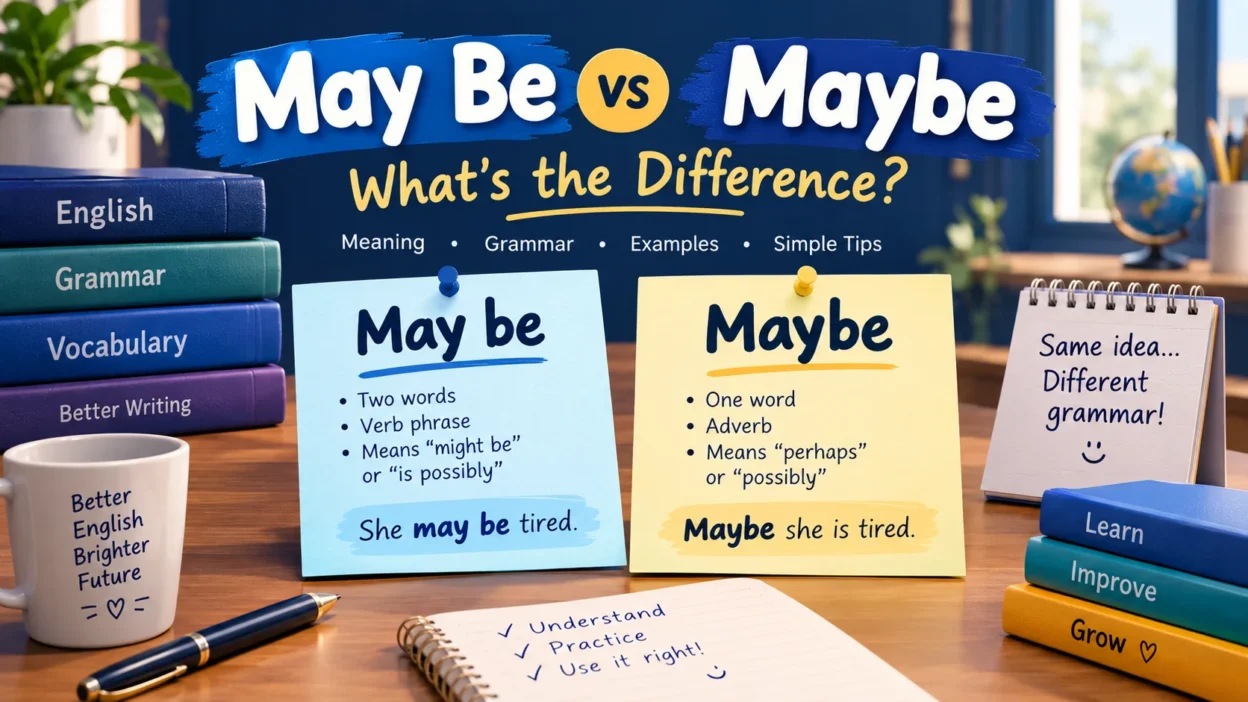
The main difference between may be and maybe is that “may be” is a verb phrase that expresses possibility, while “maybe” is an adverb that means “perhaps” or “possibly.” For example, “She may be tired” expresses the possibility that she is tired, while “Maybe she is tired” expresses the same idea using a different sentence structure. Both are correct, but they cannot always be used interchangeably. Understanding their grammatical roles makes it easier to choose the right form in everyday conversations, emails, essays, and professional writing.
Quick Answer: May Be vs Maybe
May be is a two-word verb phrase made up of the modal verb “may” and the verb “be.” It expresses possibility, as in “He may be busy.” Maybe is a one-word adverb meaning “perhaps,” as in “Maybe he is busy.” Both express uncertainty, but they function differently in a sentence.
Why Do People Confuse May Be and Maybe?
People often confuse may be and maybe because they sound the same when spoken and both express possibility or uncertainty.
However, their grammatical roles are different:
- May be: A verb phrase that indicates something is possible.
- Maybe: An adverb that means perhaps or possibly.
For example:
- “It may be true.” — The phrase “may be” expresses possibility.
- “Maybe it is true.” — The word “maybe” expresses uncertainty about the statement.
Both sentences communicate a similar idea, but their structures are different.
What Does May Be Mean?
May be is a two-word verb phrase consisting of the modal verb may and the base form of the verb be.
It is used to express possibility, uncertainty, or a situation that might be true.
How to Use May Be in a Sentence
The basic structure is:
Subject + may + be + complement
The complement can be an adjective, noun, or another phrase that completes the meaning.
Examples:
- She may be tired.
- He may be a good teacher.
- They may be at home.
- This may be the right answer.
In each example, “may be” expresses something that is possible but not certain.
Examples of May Be
- She may be late for the meeting.
- This may be the best solution.
- He may be interested in the job.
- They may be waiting outside.
- The weather may be cold tomorrow.
- It may be difficult to finish the project.
- Your keys may be in the kitchen.
- That may be a good idea.
- The answer may be incorrect.
- We may be able to help you.
What Does Maybe Mean?
Maybe is a one-word adverb that means “perhaps,” “possibly,” or “it is possible that.”
It is used to express uncertainty or indicate that something might happen or be true.
Unlike “may be,” it does not function as a verb phrase.
How to Use Maybe in a Sentence
“Maybe” can appear at the beginning, middle, or occasionally at the end of a sentence, depending on the intended meaning and style.
Examples:
- Maybe she is tired.
- Maybe we should leave early.
- I will maybe call you later.
- Maybe he forgot about the appointment.
In these sentences, “maybe” modifies the statement by showing uncertainty.
Examples of Maybe
- Maybe I will visit you tomorrow.
- Maybe she knows the answer.
- Maybe we can meet next week.
- Maybe he is still at work.
- Maybe it will rain tonight.
- Maybe they missed the bus.
- Maybe this is the right choice.
- Maybe you should ask your teacher.
- Maybe I left my phone at home.
- Maybe everything will be fine.
May Be vs Maybe: Comparison Table
|
Feature
|
May Be
|
Maybe
|
| — | — | — |
|
Word form
|
Two words
|
One word
|
|
Part of speech
|
Verb phrase
|
Adverb
|
|
Meaning
|
Might be; is possibly
|
Perhaps; possibly
|
|
Grammar
|
Uses a subject followed by may be
|
Modifies a statement or clause
|
|
Example
|
She may be busy.
|
Maybe she is busy.
|
|
Can be replaced with “perhaps”?
|
Not directly in the same structure
|
Yes, in many contexts
|
|
Common use
|
Expressing a possible state or condition
|
Expressing uncertainty about a statement
|
When Should You Use May Be or Maybe?
Choosing between these expressions depends on how the sentence is structured.
Use May Be When You Need a Verb Phrase
Use may be when you want to express the possibility of a state, identity, condition, or situation.
Examples:
- He may be sick.
- The package may be delayed.
- This may be the answer.
Tip: If the sentence needs the verb “be” after “may,” use two words.
Use Maybe When You Mean Perhaps
Use maybe when you want to express uncertainty about an entire statement or possibility.
Examples:
- Maybe he is sick.
- Maybe the package is delayed.
- Maybe this is the answer.
Tip: If you can replace “maybe” with “perhaps” without changing the basic meaning, the one-word form is usually correct.
12 Examples of May Be vs Maybe in Sentences
Here are practical examples showing how both forms can express similar ideas.
|
May Be
|
Maybe
|
| — | — |
|
She may be at school.
|
Maybe she is at school.
|
|
He may be tired.
|
Maybe he is tired.
|
|
They may be busy.
|
Maybe they are busy.
|
|
It may be expensive.
|
Maybe it is expensive.
|
|
This may be true.
|
Maybe this is true.
|
|
We may be late.
|
Maybe we will be late.
|
|
The answer may be wrong.
|
Maybe the answer is wrong.
|
|
She may be a doctor.
|
Maybe she is a doctor.
|
|
The road may be closed.
|
Maybe the road is closed.
|
|
He may be sleeping.
|
Maybe he is sleeping.
|
|
It may be too difficult.
|
Maybe it is too difficult.
|
|
The meeting may be canceled.
|
Maybe the meeting will be canceled.
|
These examples show that both expressions can communicate uncertainty, but the words that follow them may need to change to make the sentence grammatically correct.
Common Mistakes When Using May Be and Maybe
Even experienced English learners sometimes mix up these expressions. Here are some common errors and their corrections.
Mistake 1: Writing Maybe Instead of May Be
Incorrect: She maybe tired.
Correct: She may be tired.
Why? “Tired” is an adjective, and the sentence needs the verb phrase “may be.”
Mistake 2: Writing May Be Instead of Maybe
Incorrect: May be we should leave now.
Correct: Maybe we should leave now.
Why? The sentence needs an adverb meaning “perhaps” at the beginning.
Mistake 3: Using May Be Without a Subject
Incorrect: May be raining tomorrow.
Correct: It may be raining tomorrow.
Why? A complete sentence generally needs a subject. In this example, “it” is the subject.
Mistake 4: Confusing Maybe With May
Incorrect: Maybe I go to the store later. (if the intended meaning is possibility)
Better: Maybe I will go to the store later.
Why? “Maybe” expresses uncertainty, while the rest of the sentence must still use an appropriate verb structure.
Memory Trick: How to Remember May Be vs Maybe
Use these simple tricks to remember the difference:
- May be = might be. If you can replace it with “might be,” the two-word form may be correct.
- Maybe = perhaps. If you can replace it with “perhaps,” use the one-word form.
Examples:
- She may be happy. → She might be happy.
- Maybe she is happy. → Perhaps she is happy.
Remember: “May be” contains a verb, while “maybe” is an adverb.
American vs British English: May Be vs Maybe
There is no significant difference between American and British English in the use of may be and maybe.
Both varieties use:
- May be as a verb phrase expressing possibility.
- Maybe as an adverb meaning perhaps or possibly.
Examples in both varieties:
- “She may be right.”
- “Maybe she is right.”
The spelling and grammatical distinction remain the same in both American and British English.
Similar Words and Expressions
Several other English expressions are related to may be and maybe.
|
Word or Phrase
|
Meaning
|
Example
|
| — | — | — |
|
Perhaps
|
Possibly; maybe
|
Perhaps we should wait.
|
|
Possibly
|
In a way that may happen or be true
|
It could possibly work.
|
|
Might be
|
Expresses possibility
|
He might be busy.
|
|
Could be
|
Indicates a possible situation
|
That could be the answer.
|
|
May
|
Expresses possibility or permission
|
It may rain later.
|
|
Probably
|
Indicates that something is likely
|
She will probably arrive soon.
|
Although these expressions are related, they are not always interchangeable. “Probably,” for example, generally suggests a greater likelihood than “maybe.”
Final Verdict: May Be vs Maybe
The difference between may be and maybe is simple once you understand their grammatical roles.
- May be is a two-word verb phrase that expresses possibility, as in “He may be right.”
- Maybe is a one-word adverb meaning perhaps, as in “Maybe he is right.”
Both expressions are correct English. The right choice depends on the sentence structure and the meaning you want to communicate.
Frequently Asked Questions (FAQs)
1. Is it maybe or may be?
Both are correct, but they have different grammatical functions. Use “maybe” when you mean “perhaps” and “may be” when you need a verb phrase expressing possibility.
2. What is the main difference between may be and maybe?
“May be” is a verb phrase made up of “may” and “be,” while “maybe” is an adverb meaning “perhaps” or “possibly.”
3. Is maybe one word or two?
“Maybe” is one word. It is an adverb used to express uncertainty or possibility.
4. Can I use maybe and may be interchangeably?
Not directly. Although they can express similar ideas, they have different grammatical structures. For example, “She may be tired” and “Maybe she is tired” are both correct.
5. How do I know when to use maybe in a sentence?
Use “maybe” when you mean “perhaps.” For example: “Maybe we should leave early.”
6. Is may be grammatically correct?
Yes. “May be” is grammatically correct when used as a verb phrase to express possibility, as in “The answer may be correct.”
7. What is another word for maybe?
Common alternatives include “perhaps,” “possibly,” and “potentially,” depending on the context.
8. Is maybe formal or informal?
“Maybe” is acceptable in both formal and informal English. In formal writing, “perhaps” may sometimes be preferred depending on the sentence and tone.
Remember This
- May be = might be.
- Maybe = perhaps.
- Use “may be” when you need a verb phrase.
- Use “maybe” when you want to express uncertainty with an adverb.
Conclusion
Understanding the difference between may be and maybe helps you write clearer and more accurate English. Although both expressions communicate possibility, “may be” functions as a verb phrase, while “maybe” works as an adverb meaning “perhaps.” Recognizing this distinction makes it easier to use them correctly in everyday conversations, academic writing, and professional communication.
The easiest way to remember the difference is to replace “may be” with “might be” and “maybe” with “perhaps.” If the replacement makes sense, you can usually identify the correct form. With a little practice, choosing between these two expressions will become much easier.

David Henry is a language enthusiast and content writer specializing in synonyms, vocabulary, and word meanings. He creates clear, engaging resources that help readers improve their writing, communication, and English skills.