Have you ever heard someone say “copy that” or “roger that” during a conversation, on a radio, or in a movie? Both expressions are used to acknowledge a message, but they have slightly different meanings and histories. Understanding the difference between copy that and roger that can help you communicate more clearly in everyday conversations, professional settings, and situations where instructions matter.
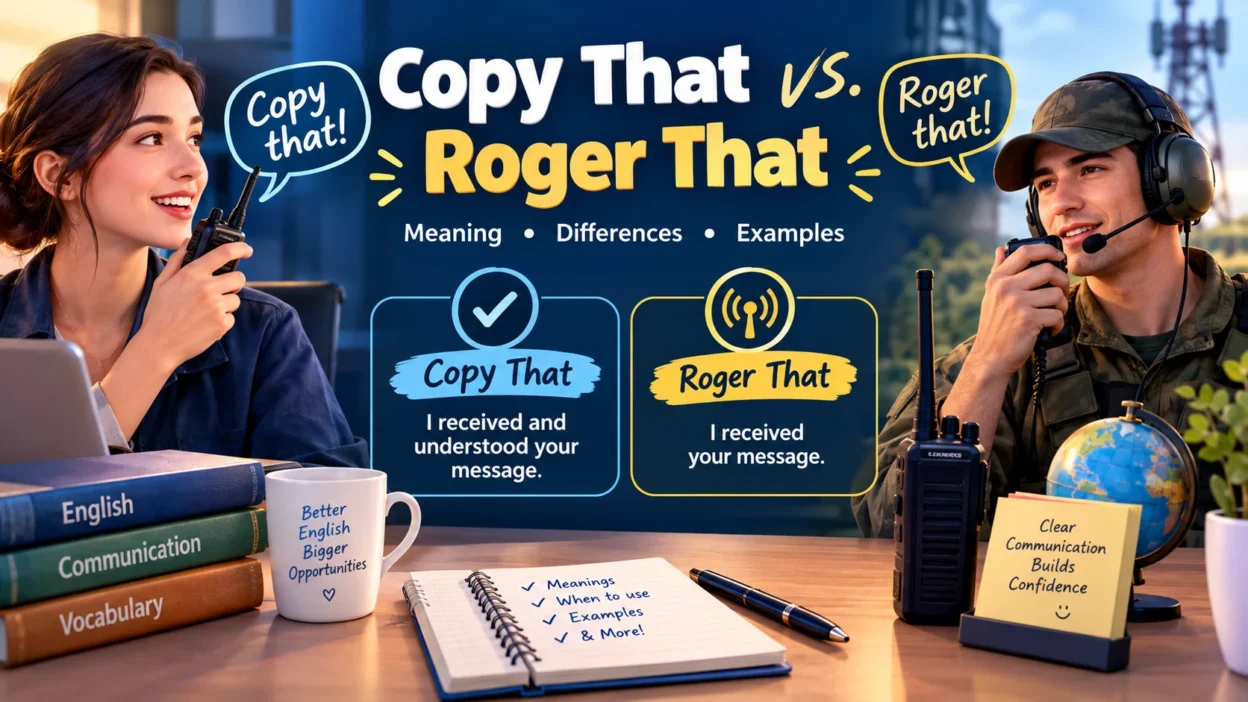
“Copy that” means “I received and understood your message.” “Roger that” also confirms that a message has been received, but it is more closely associated with radio communication, military language, and formal or tactical settings. Although the two expressions are often interchangeable, they can create slightly different impressions depending on the context.
In this guide, you will learn what each phrase means, how to use it correctly, and when one expression sounds more natural than the other. You will also find practical examples, common mistakes, and answers to frequently asked questions.
Quick Answer
“Copy that” and “roger that” both mean that a message has been received and acknowledged. “Copy that” is common in everyday and professional conversations, while “roger that” has a stronger association with radio communication and military language. Neither phrase automatically means “I agree” or “I will do it.”
Why Do People Confuse Copy That and Roger That?
People often confuse these expressions because they serve a similar purpose: acknowledging information.
Both phrases can be used after someone gives instructions, shares an update, or communicates important information.
For example:
- “Meet me at the entrance at 5 PM.” — “Copy that.”
- “Meet me at the entrance at 5 PM.” — “Roger that.”
Both replies indicate that the speaker has received the message.
However, there are subtle differences in tone, origin, and typical usage. Knowing these differences helps you choose the right expression for the situation.
What Does “Copy That” Mean?
“Copy that” means “I received and understood what you said.” It is commonly used in radio communication, workplaces, casual conversations, and situations where someone needs to acknowledge instructions.
The phrase comes from communication practices in which “copy” means to receive or accurately record a message.
How to Use Copy That
Use “copy that” when you want to confirm that you have received a message or understood an instruction.
Examples:
- “Please send me the report before noon.” — “Copy that.”
- “The meeting has been moved to Room 4.” — “Copy that.”
- “Take the next exit.” — “Copy that.”
It is a concise, practical expression that works well in informal and professional communication.
What Does “Roger That” Mean?
“Roger that” means “I have received your message.” It originated in radio communication, where “Roger” was used to represent the letter R, meaning “received.”
The phrase became widely associated with military communication, aviation, and other settings that use radio procedures. Today, people also use it casually to acknowledge instructions or respond playfully.
How to Use Roger That
Use “roger that” when you want to acknowledge a message with a radio-style or slightly more formal tone.
Examples:
- “Proceed to the next checkpoint.” — “Roger that.”
- “Your assignment is due tomorrow.” — “Roger that.”
- “Please keep the door closed.” — “Roger that.”
In everyday conversation, it can sound humorous, enthusiastic, or deliberately dramatic.
Copy That vs. Roger That: Comparison Table
|
Feature
|
Copy That
|
Roger That
|
| — | — | — |
|
Meaning
|
I received and understood your message
|
I received your message
|
|
Origin
|
Communication and radio usage
|
Radio communication, using R for received
|
|
Tone
|
Neutral, practical, conversational
|
Radio-style, sometimes formal or playful
|
|
Common settings
|
Work, casual conversations, radio communication
|
Military-style communication, aviation, casual conversations
|
|
Confirms receipt
|
Yes
|
Yes
|
|
Confirms agreement
|
Not necessarily
|
Not necessarily
|
|
Confirms action
|
Not necessarily
|
Not necessarily
|
|
Everyday use
|
Common
|
Common, often more expressive
|
When Should You Use Each Expression?
Both phrases can work in similar situations, but the context and tone can help you decide which one to use.
When to Use “Copy That”
Use “copy that” when:
- You want to acknowledge instructions at work.
- You need to confirm that you received information.
- You are communicating through a radio or messaging system.
- You want a short, direct response.
- You are having a casual conversation with friends or colleagues.
Example: “Please email me the updated schedule.” — “Copy that.”
When to Use “Roger That”
Use “roger that” when:
- You are participating in radio-style communication.
- You want to acknowledge instructions in a military-inspired or aviation context.
- You are joking around with friends using a radio-style expression.
- You want your response to sound energetic or playful.
- You are responding to a straightforward message that does not require a detailed answer.
Example: “We leave in five minutes.” — “Roger that!”
12 Examples of Copy That vs. Roger That in Sentences
Here are 12 practical examples showing how both expressions work in different situations.
1. At Work
- Copy that: “Please finish the presentation by 3 PM.” — “Copy that.”
- Roger that: “Please finish the presentation by 3 PM.” — “Roger that.”
Both acknowledge the deadline.
2. During a Phone Conversation
- Copy that: “I’ll call you when I arrive.” — “Copy that.”
- Roger that: “I’ll call you when I arrive.” — “Roger that.”
Both confirm receipt of the message.
3. While Driving
- Copy that: “Turn left at the next intersection.” — “Copy that.”
- Roger that: “Turn left at the next intersection.” — “Roger that.”
Both acknowledge the direction.
4. In a Team Meeting
- Copy that: “Everyone should submit their reports by Friday.” — “Copy that.”
- Roger that: “Everyone should submit their reports by Friday.” — “Roger that.”
Both show that the speaker has heard the instruction.
5. In Radio Communication
- Copy that: “Unit 4, move to the next location.” — “Copy that.”
- Roger that: “Unit 4, move to the next location.” — “Roger that.”
Both can acknowledge a message, although actual radio procedures may require more specific wording.
6. With Friends
- Copy that: “Bring snacks to the party.” — “Copy that.”
- Roger that: “Bring snacks to the party.” — “Roger that!”
The second response may sound more playful.
Common Mistakes When Using Copy That and Roger That
Although these expressions are easy to understand, some mistakes can lead to confusion.
Mistake 1: Assuming They Mean “I Agree”
Neither expression automatically means that you agree with a statement.
– “The new plan is perfect.” — “Copy that.”
This acknowledges the message but does not necessarily express agreement.
If you agree, say “I agree” or “That sounds good.”
Mistake 2: Assuming They Guarantee Action
Acknowledging an instruction does not always mean that you have completed it or promise to complete it.
– “Send the document today.” — “Roger that.”
This confirms receipt, not completion.
To make a clear commitment, say, “Understood. I’ll send it today.”
Mistake 3: Using Them in Every Professional Situation
Both expressions can sound too casual in formal business writing.
Instead of replying to a formal email with “Roger that,” you might write:
“Thank you for the information. I understand.”
Mistake 4: Treating Them as Completely Identical
The phrases overlap in meaning, but their tone and associations differ. “Copy that” is often more neutral, while “roger that” can sound more radio-oriented or playful.
Memory Trick: How to Remember the Difference
Use this simple memory trick:
- Copy that = Copy the message. You received and understood the information.
- Roger that = Received the message. You acknowledge that the message came through.
Think of “copy” as receiving information and “Roger” as a traditional radio acknowledgment.
Both expressions confirm receipt, but neither automatically confirms agreement or action.
American vs. British English: Copy That and Roger That
Both expressions are understood in American and British English.
|
Expression
|
American English
|
British English
|
| — | — | — |
|
Copy that
|
Common in casual, workplace, and radio communication
|
Understood and used in similar contexts
|
|
Roger that
|
Common in radio-style, military-inspired, and casual speech
|
Understood and used in similar contexts
|
There is no major difference in the core meaning of either expression between American and British English. The main differences come from the situation, tone, and speaker’s communication style.
Similar Words and Expressions
Several other expressions can be used to acknowledge a message.
|
Expression
|
Meaning
|
Typical Use
|
| — | — | — |
|
Understood
|
I understand the message
|
Professional and everyday conversations
|
|
Got it
|
I understand or have received the information
|
Casual conversations
|
|
Acknowledged
|
I have received and recognized the message
|
Formal or operational communication
|
|
Message received
|
I have received your message
|
Direct communication
|
|
10-4
|
Message received or understood in radio-style language
|
Radio communication and casual speech
|
|
Affirmative
|
Yes
|
Radio communication and formal responses
|
|
Will do
|
I will carry out the requested action
|
Responding to instructions
|
|
Noted
|
I have taken note of the information
|
Workplace communication
|
These expressions are not perfect substitutes in every situation. For example, “affirmative” means yes, while “copy that” mainly acknowledges receipt.
Final Verdict: Copy That or Roger That?
“Copy that” and “roger that” both acknowledge that a message has been received. The main difference is their tone and typical context.
Choose “copy that” for a neutral, straightforward acknowledgment in everyday or professional conversations. Choose “roger that” when you want a radio-style acknowledgment or a playful, military-inspired tone.
If you need to confirm that you will complete a task, use a clearer response such as “Understood. I’ll take care of it.”
Frequently Asked Questions (FAQs)
1. Is “copy that” the same as “roger that”?
They have similar meanings. Both acknowledge that a message has been received, but “copy that” is often more neutral, while “roger that” is more closely associated with radio communication.
2. Is “roger that” formal or informal?
“Roger that” can be used in formal operational communication, but in everyday conversations, it often sounds casual, playful, or radio-inspired.
3. Is “copy that” professional?
Yes. “Copy that” can be appropriate in informal workplace communication, team discussions, and operational settings. In formal business writing, “Understood” or “Acknowledged” may sound more suitable.
4. Does “roger that” mean “yes”?
Not exactly. “Roger that” means that a message has been received. “Yes” or “affirmative” directly expresses agreement or a positive response.
5. Can I use “copy that” in a text message?
Yes. You can use “copy that” in text messages to acknowledge instructions, plans, or information. It is especially useful when you want a short, direct reply.
6. What does “10-4” mean compared with “roger that”?
“10-4” is a radio code commonly used to mean “message received” or “understood.” “Roger that” also acknowledges receipt of a message. Both are associated with radio communication, but their exact use depends on the communication system.
7. Which phrase should I use in a professional email?
“Understood,” “Acknowledged,” or “Thank you for the information” is usually more suitable for formal emails. “Copy that” may work in a casual workplace, while “roger that” can sound overly informal or playful.
Remember This
- Copy that: I received and understood your message.
- Roger that: I received your message.
- Both acknowledge information, but neither automatically means agreement or a promise to act.
- “Copy that” is often neutral; “roger that” has a stronger radio-style association.
Conclusion
“Copy that” and “roger that” are useful expressions for acknowledging information in everyday conversations, workplaces, and radio communication. Although they share a similar meaning, their tone and typical settings can differ. “Copy that” is often a straightforward acknowledgment, while “roger that” carries a traditional radio-style feel.
The key is to consider what you want to communicate. If you simply need to confirm that you received a message, either expression may work. If you need to express agreement or promise to complete a task, choose a more specific response such as “I agree” or “I’ll take care of it.”

David Henry is a language enthusiast and content writer specializing in synonyms, vocabulary, and word meanings. He creates clear, engaging resources that help readers improve their writing, communication, and English skills.