
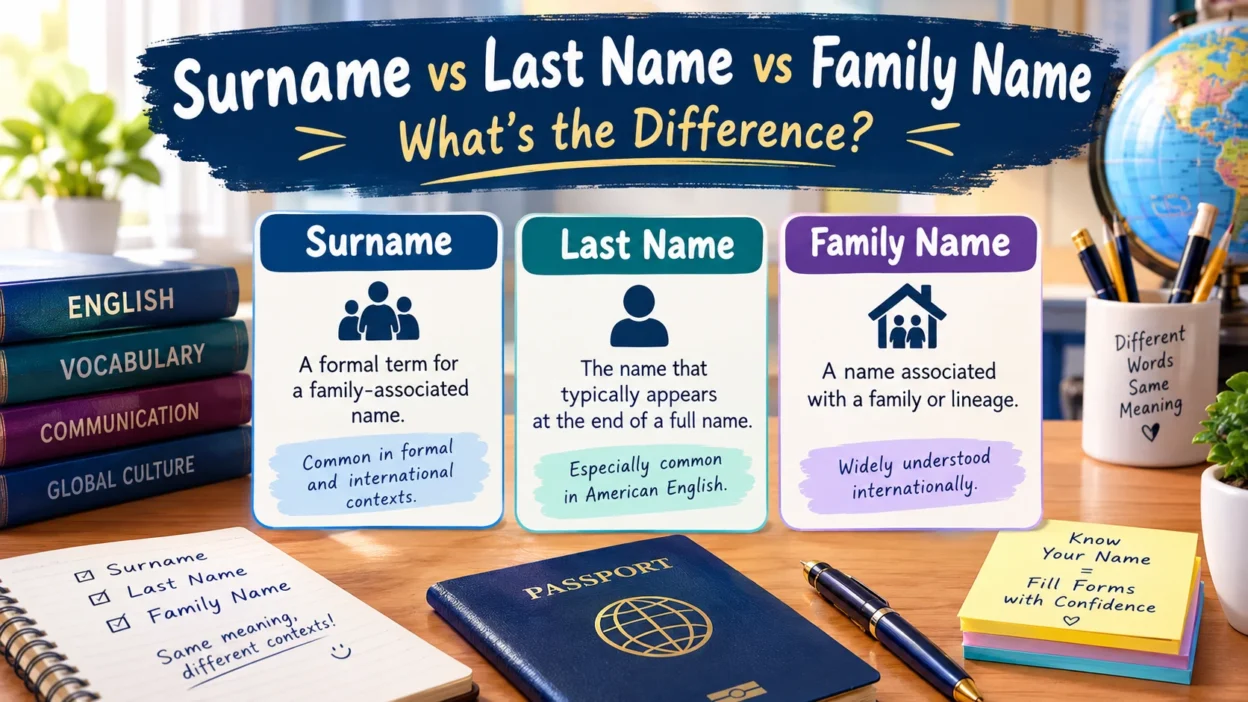
Have you ever wondered if surname, last name, and family name mean the same thing? These three terms often appear on official documents, school forms, passports, and job applications. Although they may look different, they generally refer to the same part of a person’s name.
The main difference is how these terms are used. Surname is common in formal and international contexts, last name is widely used in American English, and family name is a clear, widely understood term that emphasizes the name shared by family members. However, naming traditions vary across cultures, and a family name does not always appear at the end of a person’s full name. Understanding these differences can help you fill out forms correctly, communicate clearly, and avoid confusion when discussing personal names in English.
Quick Answer
Surname, last name, and family name usually mean the same thing: the part of a person’s name associated with their family or inherited naming tradition. Surname is common in formal contexts, last name is especially common in American English, and family name is widely understood internationally. Their position in a full name depends on cultural naming conventions.
Why Do People Confuse Surname, Last Name, and Family Name?
People confuse these terms because they often refer to the same part of a person’s name.
For example:
- Surname: Common in formal and international English.
- Last name: Common in everyday American English.
- Family name: A widely understood term used in everyday and official contexts.
The confusion becomes greater when people encounter different naming traditions. In some cultures, the family name comes first, while in others, it usually comes last.
For example, in the name John Smith, Smith is the surname, last name, and family name.
In the Chinese name Wang Wei, Wang is typically the family name, even though it appears first.
1. What Does Surname Mean?
A surname is a name associated with a family or inherited naming tradition. It is often passed down through generations and is commonly used to distinguish people who share the same given name.
The word is widely used in British English, formal writing, and international documents.
Examples of Surname
- Emma Johnson — Johnson is the surname.
- David Brown — Brown is the surname.
- Olivia Taylor — Taylor is the surname.
- Michael Wilson — Wilson is the surname.
How to Use Surname in a Sentence
- Please write your surname on the application form.
- Her surname is Patel.
- I forgot how to spell his surname.
- The students were listed by surname.
- What is your surname?
When to use it: Use surname in formal communication, academic contexts, and situations where a person’s family name needs to be identified clearly.
2. What Does Last Name Mean?
A last name is the name that typically appears at the end of a person’s full name in naming systems that place the family name last.
It is especially common in American English and everyday conversation.
For example, in Sarah Miller, Miller is the last name.
Examples of Last Name
- Sarah Miller — Miller is the last name.
- James Anderson — Anderson is the last name.
- Emily Davis — Davis is the last name.
- Daniel Thomas — Thomas is the last name.
How to Use Last Name in a Sentence
- What is your last name?
- Please enter your last name below.
- My last name is Anderson.
- She changed her last name after marriage.
- The teacher called us by our last names.
When to use it: Use last name in everyday conversation, especially in the United States, and when a form specifically asks for a last name.
3. What Does Family Name Mean?
A family name is a name associated with a family or lineage. It is often inherited and shared among relatives, although naming traditions differ around the world.
The term is widely understood in international English and frequently appears on official forms, travel documents, and applications.
Examples of Family Name
- Maria Garcia — Garcia is the family name.
- Ahmed Khan — Khan is the family name.
- Lisa Chen — Chen is the family name.
- Robert Wilson — Wilson is the family name.
How to Use Family Name in a Sentence
- Please enter your family name as it appears on your passport.
- Her family name is Garcia.
- We have the same family name.
- The form asks for your given name and family name.
- His family name comes from his father’s side of the family.
When to use it: Use family name when communicating internationally or when a form uses this exact label.
Surname vs Last Name vs Family Name: Comparison Table
|
Term
|
Meaning
|
Common Usage
|
Example
|
| — | — | — | — |
|
Surname
|
Family-associated name
|
Formal and international English
|
Smith
|
|
Last name
|
Name typically placed last
|
Especially American English
|
Smith
|
|
Family name
|
Name associated with a family
|
International and official contexts
|
Smith
|
Key point: These terms are usually interchangeable when referring to the same family-associated name, but cultural naming conventions can affect which part of a full name they identify.
When Should You Use Each Term?
Choosing between these terms depends on the situation, audience, and naming tradition.
Use Surname When:
- Writing formal letters or academic documents.
- Completing a form that specifically asks for a surname.
- Speaking in a context where formal English is affirming name.
Example: Please write your surname in capital letters.
Use Last Name When:
- Speaking casually in American English.
- Asking someone for their name in everyday conversation.
- Completing a form that uses the label “Last Name.”
Example: What’s your last name?
Use Family Name When:
- Completing an international application.
- Discussing family naming traditions.
- Filling out a form that uses the label “Family Name.”
Example: Enter your family name exactly as it appears on your passport.
12 Examples of Surname vs Last Name vs Family Name
Here are practical examples showing how the three terms are used.
|
Sentence
|
Meaning
|
| — | — |
|
1. What is your surname?
|
Asking for a person’s family-associated name.
|
|
2. What is your last name?
|
Asking for the same name in everyday English.
|
|
3. Please enter your family name.
|
Requesting the family-associated name.
|
|
4. Her surname is Wilson.
|
Wilson is her family-associated name.
|
|
5. My last name is Brown.
|
Brown is the name used at the end of the full name.
|
|
6. Their family name is Khan.
|
Khan is the family’s associated name.
|
|
7. Please write your surname on the form.
|
Enter the family-associated name.
|
|
8. I share the same last name as my brother.
|
The siblings have the same last name.
|
|
9. The family name appears first in this naming tradition.
|
The family-associated name comes before the given name.
|
|
10. Her surname is difficult to pronounce.
|
Her family-associated name is difficult to say.
|
|
11. The form asks for your last name.
|
The form requests the family-associated name.
|
|
12. Please check the spelling of your family name.
|
Make sure the family-associated name is spelled correctly.
|
Common Mistakes to Avoid
Even though these terms are similar, a few mistakes can cause confusion.
1. Assuming the Family Name Always Comes Last
Not every culture places the family name at the end of a full name.
For example, in the Chinese name Wang Wei, Wang is typically the family name.
2. Confusing a Given Name With a Surname
A given name is the personal name assigned to someone, while a surname is generally associated with their family.
Example:
- Full name: Emma Johnson
- Given name: Emma
- Surname: Johnson
3. Thinking Family Name Always Means a Shared Name
Some families have different surnames, and some people use multiple family-associated names. A family name does not necessarily have to be identical for every member of a family.
4. Using a Different Name From the One on an Official Document
When completing official paperwork, use the name and spelling requested by the form and follow the instructions provided.
Memory Trick: How to Remember the Difference
Use this simple memory trick:
- Surname: Think of a formal name for a family-associated name.
- Last name: Think of the name that often comes last in a full name.
- Family name: Think of a name connected to a family.
Remember that last name describes a position in many naming systems, while surname and family name describe the type of name.
American vs British English: Is There a Difference?
The main difference is how frequently each term is used.
|
Term
|
American English
|
British English
|
| — | — | — |
|
Surname
|
Common, especially on formal forms
|
Very common
|
|
Last name
|
Very common in everyday speech
|
Common and widely understood
|
|
Family name
|
Common in formal and international contexts
|
Common and widely understood
|
In American English, people often ask, “What’s your last name?”
In British English, “What’s your surname?” is also a common way to ask the same question.
All three terms are understood in both varieties of English.
Similar Words Related to Surname, Last Name, and Family Name
These terms are related to personal names, but they do not all mean the same thing.
1. Given Name
A given name is the personal name assigned to someone, such as Emma in Emma Johnson.
2. First Name
A first name is the name that usually appears first in a person’s full name in Western naming conventions.
Example: Emma in Emma Johnson.
3. Middle Name
A middle name is a name that appears between a person’s first or given name and their surname in some naming traditions.
Example: Marie in Emma Marie Johnson.
4. Full Name
A full name is the complete name a person uses or is officially recorded under, including the relevant given names and family-associated names.
5. Maiden Name
A maiden name traditionally refers to a surname a woman used before marriage, particularly when it changes after marriage.
6. affirming Name
A affirming name is the name a person chooses to be called, which may differ from their legal or official name.
FAQs About Surname vs Last Name vs Family Name
1. Are surname, last name, and family name the same?
Yes, they usually refer to the same family-associated name. The main difference is regional usage and context.
2. Is a surname the same as a last name?
In most English-speaking contexts, yes. Both terms usually refer to the family-associated name, which often appears at the end of a person’s full name.
3. Is a family name the same as a surname?
Yes, in most cases. Both terms generally refer to a name associated with a person’s family or lineage.
4. Which term is more common in American English?
Last name is especially common in everyday American English, although surname and family name are also widely understood.
5. Which term is more common in British English?
Surname is very common in British English, particularly in formal contexts. Last name and family name are also used.
6. What is the difference between a given name and a surname?
A given name identifies a person individually, while a surname is generally associated with their family or lineage.
For example, in Emma Johnson, Emma is the given name and Johnson is the surname.
7. Does the surname always come last?
No. In some naming traditions, the family name comes first. The position of a surname depends on cultural naming conventions.
8. What should I write if a form asks for my family name?
Enter the family-associated name requested by the form, following the form’s instructions and the spelling on your official documents.
Remember This
- Surname: A formal and widely used term for a family-associated name.
- Last name: A common everyday term, especially in American English.
- Family name: A widely understood term for a name associated with a family.
These terms usually refer to the same thing, but cultural naming traditions can affect how names are ordered.
Conclusion
Surname, last name, and family name generally mean the same thing: a name associated with a person’s family or lineage. The main difference is their usage. Surname is common in formal contexts, last name is especially common in American English, and family name is widely understood internationally.
When using these terms, remember that not every culture places the family name at the end of a full name. If you are completing an official form, follow its instructions and use the name exactly as it appears on your relevant documents. Understanding these distinctions will help you communicate clearly and avoid common naming mistakes.

David Henry is a language enthusiast and content writer specializing in synonyms, vocabulary, and word meanings. He creates clear, engaging resources that help readers improve their writing, communication, and English skills.