
Introduction:
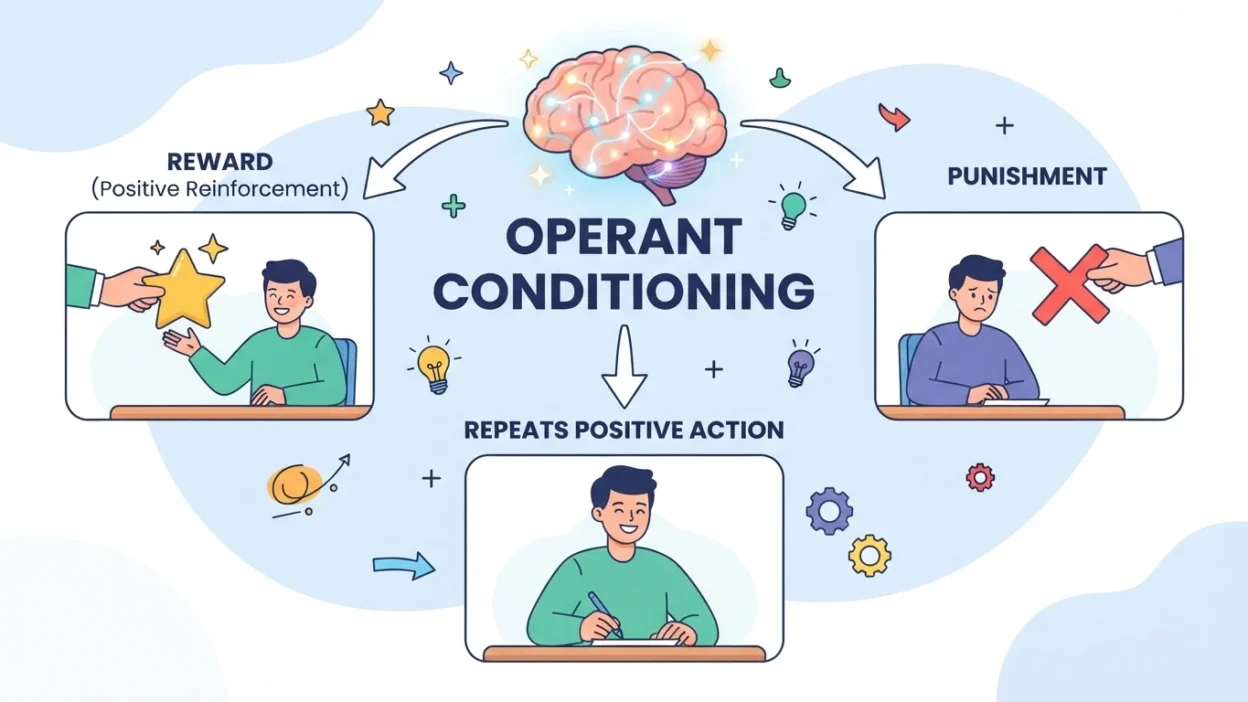
Have you ever wondered why rewards and punishments can change how people or animals behave? This is the core of operant conditioning. In simple terms, operant conditioning is a learning method where the consequences of a behavior—like a reward or a punishment—affect whether that behavior will happen again in the future.
For students, ESL learners, and writers, understanding the term “operant conditioning” is just the first step. To truly master this concept and use it in your writing, it is helpful to know its synonyms. Using different terms for the same idea can make your essays, articles, and research papers more engaging and clear. This guide explores the many “operant conditioning synonyms” and explains when to use each one.
Meaning of the Keyword
Before we dive into the list of synonyms, it is important to have a solid grasp of the core meaning. Operant conditioning is often called “learning through consequences.” A behavior is more likely to be repeated if it is followed by a positive result (reinforcement). Conversely, a behavior is less likely to be repeated if it is followed by a negative result (punishment) .
For example, imagine a student who studies hard and gets a good grade. The good grade reinforces the study behavior, making it more likely to happen again. This learning process is what psychologists refer to as operant conditioning.
30 Synonyms of Operant Conditioning
Here are the most common “operant conditioning synonyms” and related terms. Each entry includes a simple explanation, an example, and the best usage context.
1. Instrumental Conditioning
- Meaning: This is the most direct synonym for operant conditioning. It refers to learning where a behavior is performed because it is “instrumental” in achieving a goal or reward .
- Example: The dog learned to sit because it was instrumental in getting a treat.
- Best Usage: Use this in academic or scientific writing when you want to highlight the goal-directed nature of the learning .
2. Skinnerian Conditioning
- Meaning: Named after B.F. Skinner, the psychologist who famously studied this type of learning.
- Example: Skinner’s experiments with rats in boxes are classic examples of Skinnerian conditioning.
- Best Usage: Use this when referencing historical experiments or discussing behaviorism specifically .
3. Instrumental Learning
- Meaning: Similar to instrumental conditioning, it emphasizes that the learning involves performing actions to achieve an effect.
- Example: Children often engage in instrumental learning when they realize that saying “please” gets them what they want.
- Best Usage: Use this in educational contexts to describe how students learn through action and consequence .
4. Response-Stimulus Learning
- Meaning: This term highlights that learning involves a connection between a response (behavior) and a stimulus (consequence).
- Example: The rat pressing the lever (response) to receive food (stimulus) is response-stimulus learning.
- Best Usage: Use this in psychological or neuroscience articles requiring specific terminology.
5. Operant Learning
- Meaning: A simple, shortened version of operant conditioning.
- Example: Operant learning is used in many modern teaching methods.
- Best Usage: Use this for a general audience to sound natural and avoid overly technical jargon.
6. Trial-and-Error Learning
- Meaning: This is a related concept where learning occurs by trying different actions until one is successful.
- Example: A baby learning to walk is often a process of trial-and-error learning.
- Best Usage: Use this when the process involves repeated attempts before mastering the behavior.
7. Reward Learning
- Meaning: This focuses specifically on the role of rewards in shaping behavior.
- Example: Many apps use reward learning by giving points for completing daily tasks.
- Best Usage: Use this in discussions about education, parenting, or gamification.
8. Consequence-Based Learning
- Meaning: A broad term that explains the concept clearly for a general audience.
- Example: Consequence-based learning is crucial in animal training.
- Best Usage: Use this in ESL contexts or when writing for beginners.
9. Associative Learning (Specifically)
- Meaning: While classical conditioning is also associative, this term can apply to operant conditioning because it associates a behavior with a consequence .
- Example: The child associated saying “thank you” with positive attention.
- Best Usage: Use this when comparing different types of learning theories.
10. Shaping
- Meaning: This is a technique used in operant conditioning where you reward small steps toward a final goal.
- Example: The trainer used shaping to teach the parrot to talk by rewarding each small sound it made.
- Best Usage: Use this when describing a gradual training or teaching process.
Comparison Table: When to Use Different Synonyms
| Synonym | Best Used For | Context |
|---|---|---|
| Instrumental Conditioning | Academic papers, psychology journals | Scientific, formal |
| Skinnerian Conditioning | History of psychology, theory discussions | Historical, academic |
| Operant Learning | General articles, everyday writing | Neutral, modern |
| Reward Learning | Parenting, education, therapy | Practical, accessible |
| Consequence-Based Learning | ESL learners, general explanations | Simple, clear |
| Shaping | Training, step-by-step teaching | Action-oriented |
How to Choose the Right Synonym
Choosing the right word depends on your audience and the tone of your writing. Here is a simple guide to help you decide.
- For Formal Academic Writing: Use “instrumental conditioning” or “Skinnerian conditioning.” These terms are recognized by experts and fit the professional tone of research papers .
- For ESL Readers or Beginners: Choose “consequence-based learning” or “operant learning.” These are the easiest terms to understand and are less likely to confuse someone new to psychology.
- For Content Creators and Bloggers: You can use “reward learning” or “trial-and-error learning.” These terms are relatable and naturally fit into modern discussions about habits and productivity.
- For Technical Discussions: Use specific terms like “response-stimulus learning” when you need to be precise about the science.
Conclusion
Mastering the vocabulary of psychology can greatly improve your writing and comprehension. While “operant conditioning” is the standard term, knowing its synonyms allows you to avoid repetition and adjust your tone for any audience. Whether you choose to say instrumental conditioning in a university essay or reward learning in a blog post, you will be communicating the same powerful idea: behavior is shaped by its consequences.

David Henry is a language enthusiast and content writer specializing in synonyms, vocabulary, and word meanings. He creates clear, engaging resources that help readers improve their writing, communication, and English skills.