Have you ever wondered if to write “putted” or “put” when talking about something you placed somewhere in the past? These two forms can be confusing because many English verbs add -ed to form their past tense. However, the verb put follows a different pattern. It is an irregular verb, which means its past tense does not follow the usual rules.
The correct past tense and past participle of put is put, not putted, when referring to placing, moving, or positioning something. For example, you should say, “I put my phone on the table yesterday,” rather than “I putted my phone on the table.” However, putted is a real English word in golf, where it describes hitting a golf ball with a putter. Understanding this distinction will help you choose the correct word in everyday conversations and writing.
Quick Answer: Putted or Put
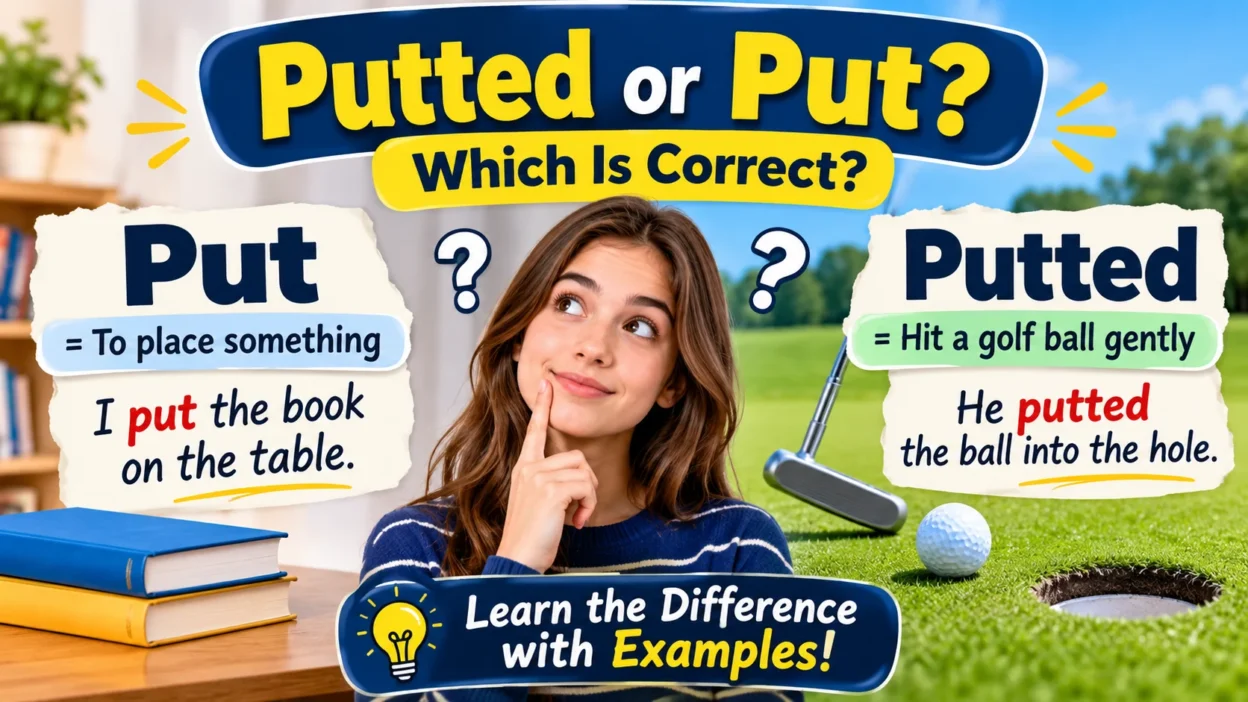
Put is the correct past tense and past participle of the verb put when it means to place or position something. For example, “She put her keys in her bag.” Putted is not correct for this meaning. However, putted is correct in golf because it refers to hitting a golf ball with a putter.
Why Do People Confuse Putted and Put?
People often confuse putted and put because most regular English verbs form their past tense by adding -ed.
For example:
- Walk → Walked
- Talk → Talked
- Open → Opened
- Play → Played
Following this pattern, some learners assume that put becomes putted in the past tense.
However, put is an irregular verb. Its base form, past simple form, and past participle are all spelled the same way.
Another reason for confusion is that putted is a legitimate word in golf. Therefore, both words exist, but they have different grammatical uses and meanings.
1. Put: Meaning, Definition, and Usage
Put is an irregular verb that means to move something into a particular position, place, or location.
It can also describe placing something in a specific condition, situation, or arrangement.
Forms of the Verb Put
| Verb form | Correct word |
|---|---|
| Base form | Put |
| Present simple | Put / Puts |
| Past simple | Put |
| Past participle | Put |
| Present participle | Putting |
When Should You Use Put?
Use put when describing the act of placing or positioning something.
Examples:
- I put my wallet in my pocket.
- She put the flowers on the table.
- He put his books inside the cupboard.
- They put their bags near the door.
- We put the chairs in the garden.
Notice that put stays the same when referring to past actions.
Put in Different Tenses
- Present: I put my clothes in the wardrobe.
- Past: I put my clothes in the wardrobe yesterday.
- Present perfect: I have put my clothes in the wardrobe.
- Past perfect: I had put my clothes in the wardrobe before leaving.
2. Putted: Meaning, Definition, and Usage
Putted is the past tense and past participle of putt, a verb mainly used in golf.
In golf, putt means to hit a golf ball gently, usually with a putter, to move it toward or into the hole.
Therefore, putted is grammatically correct when discussing this particular golfing action.
When Should You Use Putted?
Use putted when describing an action involving putting a golf ball.
Examples:
- He putted the ball into the hole.
- She putted successfully on the final green.
- The golfer putted from a short distance.
- He putted twice before reaching the hole.
- The professional player putted carefully.
Remember that putted belongs to the golfing vocabulary, not the ordinary past tense of put.
Putted vs Put: Comparison Table
| Feature | Put | Putted |
|---|---|---|
| Word type | Irregular verb form | Regular verb form |
| Base verb | Put | Putt |
| Past tense | Put | Putted |
| Past participle | Put | Putted |
| Main meaning | To place something | To hit a golf ball gently |
| Everyday usage | Very common | Mainly golf-related |
| Example | I put it there. | He putted the ball. |
When to Use Put or Putted
Choosing between these words is easy when you understand their meanings.
Use Put When:
- You are describing placing an object somewhere.
- You are talking about a past action involving positioning.
- You are using the present perfect or past perfect tense.
- You are describing moving something into a particular location.
Examples:
- I put the milk in the refrigerator.
- She put her phone on silent.
- We have put everything in its proper place.
Use Putted When:
- You are talking about golf.
- You are describing someone hitting a golf ball with a putter.
- You are explaining a player’s performance on a golf green.
Examples:
- He putted the ball into the hole.
- She putted from the edge of the green.
- The golfer putted beautifully during the final round.
12 Examples of Put and Putted in Sentences
Here are practical examples to help you understand the difference.
Examples of Put
- I put my laptop on the desk.
- She put her shoes beside the bed.
- He put the documents in a folder.
- They put their money in the bank.
- My mother put dinner on the table.
- We put the decorations around the room.
- I have put your name on the list.
- She put her jacket over the chair.
Examples of Putted
- The golfer putted the ball into the hole.
- He putted from several feet away.
- She putted confidently during the competition.
- The player putted the ball across the green.
Common Mistakes to Avoid
English learners sometimes make mistakes when using put because they apply regular verb rules to irregular verbs.
Here are some common errors and their corrections.
| Incorrect sentence | Correct sentence |
|---|---|
| I putted my bag on the chair. | I put my bag on the chair. |
| She has putted the book away. | She has put the book away. |
| He putted his phone in his pocket. | He put his phone in his pocket. |
| They have putted everything inside. | They have put everything inside. |
| I had putted the keys there. | I had put the keys there. |
Important: Do not add -ed to put when you mean placing or positioning something.
However, do not mistakenly avoid putted in golf-related sentences.
Memory Trick: How to Remember Put vs Putted
Use this simple trick:
Put = Place something.
Putted = Played a golf shot.
Remember these two examples:
- I put my phone on the table.
- He putted the golf ball into the hole.
If the sentence is about placing an object, choose put. If it describes hitting a golf ball, choose putted.
American vs British English
There is no meaningful difference between American and British English when using put and putted.
Both varieties follow the same grammatical rules:
- Put is the past tense and past participle of put.
- Putted is the past tense and past participle of putt in golf.
Examples in both varieties:
- American English: I put my keys on the counter.
- British English: I put my keys on the kitchen table.
- American English: He putted the ball into the hole.
- British English: He putted the ball into the hole.
The spelling and grammatical distinction remain the same.
Similar Words and Related Verb Forms
Understanding other irregular verbs can help you avoid similar mistakes.
| Base verb | Past tense | Past participle |
|---|---|---|
| Put | Put | Put |
| Cut | Cut | Cut |
| Hit | Hit | Hit |
| Set | Set | Set |
| Let | Let | Let |
| Shut | Shut | Shut |
| Cost | Cost | Cost |
| Read | Read | Read |
These verbs have the same spelling in their base form, past tense, and past participle, although the pronunciation of read changes in the past tense and past participle.
Final Verdict: Putted or Put?
The correct choice depends on what you want to express.
- Put is correct when describing placing or positioning something. It is the base form, past tense, and past participle of the verb.
- Putted is correct when describing hitting a golf ball with a putter.
For everyday English, use put, not putted, when talking about placing something somewhere.
Frequently Asked Questions (FAQs)
1. Is putted a real word?
Yes, putted is a real English word. It is the past tense and past participle of putt, which means to hit a golf ball gently toward a hole. However, it is not the standard past tense of put.
2. Is putted or put correct in the past tense?
Put is correct when describing the past action of placing something somewhere. For example, “I put my keys on the desk.” Putted is used for golf-related actions.
3. What is the past tense of put?
The past tense of put is put. The word does not change when used in the past tense.
Example: “Yesterday, I put my books in my bag.”
4. What is the past participle of put?
The past participle of put is also put.
Example: “I have put the documents on your desk.”
5. Why is put not spelled putted?
Because put is an irregular verb. Unlike regular verbs that form their past tense by adding -ed, irregular verbs follow different patterns. The word put remains unchanged in its base form, past tense, and past participle.
6. Is putted correct in golf?
Yes. Putted is the correct past tense of putt in golf.
Example: “The golfer putted the ball into the hole.”
7. Should I say I putted it there or I put it there?
You should say “I put it there.” When you mean that you placed something in a particular location, put is the correct past tense.
Remember This
- Put = To place or position something.
- Put = Past tense of put.
- Put = Past participle of put.
- Putted = Past tense of putt in golf.
- Do not use putted when describing ordinary placement.
Conclusion
Understanding the difference between putted and put is simple once you learn that put is an irregular verb. Its base form, past tense, and past participle are all identical. Therefore, when describing an action that involves placing or positioning something, always use put.
On the other hand, putted is perfectly correct in golf because it describes hitting a golf ball with a putter. Remember this small but important distinction, and you will be able to use both words confidently in everyday English, conversations, and writing.

David Henry is a language enthusiast and content writer specializing in synonyms, vocabulary, and word meanings. He creates clear, engaging resources that help readers improve their writing, communication, and English skills.