Have you ever wondered if to say “all was” or “all were”? Both expressions can be grammatically correct, but choosing the right one depends on what the word “all” refers to. Since “all” can refer to a singular amount, an entire situation, or multiple people and things, it can take either a singular or plural verb.
Understanding the difference between “all was” and “all were” will help you write clearer sentences and avoid common subject-verb agreement mistakes. For example, you can say, “All was quiet in the room” because “all” refers to an entire situation. However, “All were happy with the decision” is correct because “all” refers to several people.
In this guide, you will learn the meanings, grammatical rules, differences, and correct uses of both expressions. You will also find practical examples, common mistakes, and helpful tips to remember which form to use.
Quick Answer: All Was or All Were?
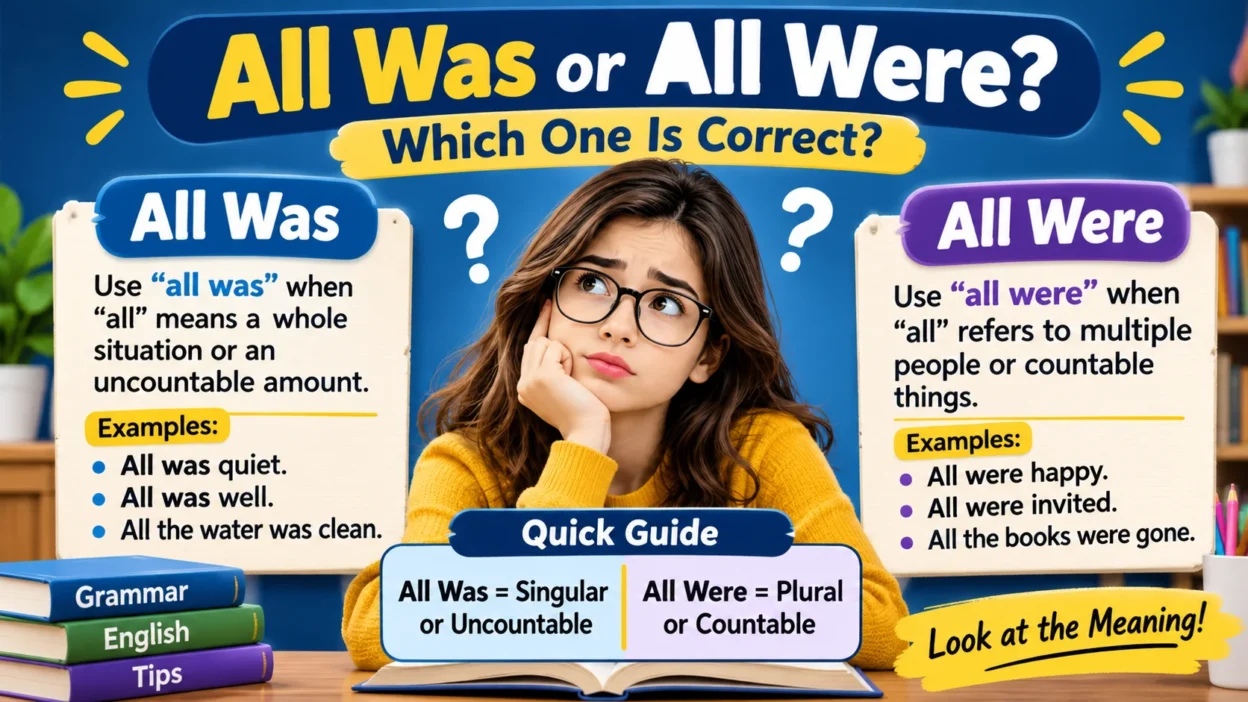
Both “all was” and “all were” are correct. Use “all was” when “all” refers to a singular or uncountable amount, condition, or situation. Use “all were” when “all” refers to multiple people or countable things. The correct choice depends on the meaning of the subject and its grammatical number.
Why Do People Confuse All Was and All Were?
People often confuse these expressions because “all” does not always behave like a singular or plural subject.
Unlike words such as “everyone” or “everything,” which generally take singular verbs, “all” can take either a singular or plural verb.
Consider these examples:
- All was lost. (All the things or everything was lost.)
- All were invited. (Every person in the group was invited.)
The confusion usually comes from overlooking what “all” represents in a sentence.
The most important rule is to identify if “all” refers to an uncountable amount or multiple countable items.
1. All Was: Meaning and Usage
“All was” is a grammatically correct expression used when “all” refers to a singular or uncountable amount, condition, or situation.
Here, “all” generally means everything, the whole situation, or the entire amount.
When Should You Use All Was?
Use “all was” in these situations:
1. When referring to an entire situation
- All was peaceful after the meeting.
- All was quiet in the house.
- All was well until the storm arrived.
2. When referring to an uncountable amount
- All the water was contaminated.
- All the information was accurate.
- All the money was spent.
3. When describing a general condition
- All was ready for the celebration.
- All was forgotten after a few years.
- All was settled before the deadline.
More Examples of All Was
- All was going according to plan.
- All was silent in the classroom.
- All was lost during the accident.
In each example, “all” refers to a whole situation or an uncountable amount, so the singular verb “was” is appropriate.
2. All Were: Meaning and Usage
“All were” is a grammatically correct expression used when “all” refers to multiple people, animals, or countable things.
It takes the plural verb “were” because the subject represents more than one person or thing.
When Should You Use All Were?
Use “all were” in these situations:
1. When referring to multiple people
- All were excited about the trip.
- All were present at the meeting.
- All were satisfied with the results.
2. When referring to countable things
- All the books were damaged.
- All the windows were open.
- All the documents were submitted.
3. When describing multiple individuals or objects
- All were invited to the wedding.
- All were ready for the competition.
- All were carefully arranged on the table.
More Examples of All Were
- All were waiting outside.
- All were aware of the situation.
- All were selected for the final round.
In these examples, “all” represents multiple people or countable things, making “were” the correct verb.
3. All Was vs All Were: Comparison Table
The following table highlights the main differences between these expressions.
| Feature | All Was | All Were |
|---|---|---|
| Verb form | Singular | Plural |
| Subject meaning | Whole situation or uncountable amount | Multiple people or things |
| Grammatical number | Singular | Plural |
| Common meaning | Everything was | Everyone or all items were |
| Example | All was quiet. | All were quiet. |
| Usage | Uncountable or singular reference | Plural reference |
Remember: The word “all” does not automatically require a plural verb. Its meaning and grammatical reference determine if you should use “was” or “were.”
4. When to Use All Was and All Were
Choosing between these expressions becomes easier when you understand what follows “all.”
Use All Was for Uncountable Nouns
Uncountable nouns refer to things that are not normally counted individually.
Examples include:
- Water: All the water was clean.
- Information: All the information was useful.
- Money: All the money was missing.
- Furniture: All the furniture was expensive.
- Advice: All the advice was helpful.
Use All Were for Plural Countable Nouns
Plural countable nouns refer to things or people that can be counted individually.
Examples include:
- Students: All the students were present.
- Cars: All the cars were expensive.
- Flowers: All the flowers were beautiful.
- Questions: All the questions were answered.
- Children: All the children were sleeping.
Use the Meaning to Decide
Sometimes, “all” appears without a noun. In these cases, consider what it represents.
- All was forgotten. (Everything was forgotten.)
- All were forgotten. (All the people or things were forgotten.)
Both sentences are possible, but their meanings are different.
5. All Was vs All Were: 15 Example Sentences
Here are 15 practical examples to help you understand the difference.
Examples Using All Was
- All was quiet after everyone left the building.
- All was well until the unexpected news arrived.
- All the food was prepared before the guests arrived.
- All the information was stored on the computer.
- All the money was spent on household expenses.
- All was lost when the company closed.
- All the furniture was delivered yesterday.
Examples Using All Were
- All the students were excited about the results.
- All were invited to attend the ceremony.
- All the employees were informed about the changes.
- All the flowers were fresh and beautiful.
- All the children were playing in the garden.
- All were happy with the final decision.
- All the questions were answered correctly.
- All the guests were waiting outside.
These examples demonstrate that the verb depends on if “all” refers to a singular or uncountable subject or a plural subject.
6. Common Mistakes When Using All Was and All Were
Even fluent English speakers sometimes make mistakes with subject-verb agreement.
Here are some common errors to avoid.
Mistake 1: Using Were With an Uncountable Noun
Incorrect
All the information were correct.
Correct
All the information was correct.
Why? Information is an uncountable noun and takes a singular verb.
Mistake 2: Using Was With a Plural Noun
Incorrect
All the students was present.
Correct
All the students were present.
Why? Students is a plural noun, so it requires “were.”
Mistake 3: Assuming All Always Takes Were
Incorrect
All the water were wasted.
Correct
All the water was wasted.
Why? Water is uncountable and takes a singular verb.
Mistake 4: Assuming All Always Takes Was
Incorrect
All the books was missing.
Correct
All the books were missing.
Why? Books is a plural countable noun.
7. Memory Trick: How to Remember All Was or All Were
A simple trick can help you choose the correct expression every time.
Remember this rule:
- All + uncountable or singular meaning = Was
- All + plural meaning = Were
Think about these examples:
- All the milk was finished.
- All the players were tired.
- All the work was completed.
- All the pictures were deleted.
Easy memory formula
WAS
One whole thing or an uncountable amount.
WERE
Multiple people or countable things.
8. All Was vs All Were in American and British English
There is no significant difference between American and British English regarding the basic grammatical rules for “all was” and “all were.”
Both varieties use:
- “All was” for singular or uncountable references.
- “All were” for plural references.
Examples in American English:
- All the equipment was ready.
- All the players were prepared.
Examples in British English:
- All the equipment was ready.
- All the players were prepared.
The spelling and grammar remain the same in these examples. The choice depends on the subject, not the English variety.
9. Similar Words and Expressions
Understanding related expressions can make subject-verb agreement easier.
| Expression | Correct Verb | Example |
|---|---|---|
| Everything | Singular | Everything was ready. |
| Everyone | Singular | Everyone was happy. |
| Everybody | Singular | Everybody was invited. |
| All the people | Plural | All the people were waiting. |
| All the water | Singular | All the water was clean. |
| Both | Plural | Both were correct. |
| Each | Singular | Each was different. |
| Some | Depends on meaning | Some was missing; some were damaged. |
All vs Everything
“Everything” takes a singular verb, while “all” can take either a singular or plural verb.
- Everything was perfect.
- All was perfect.
- All the arrangements were perfect.
All vs Everyone
“Everyone” always takes a singular verb in standard English, even though it refers to multiple people.
- Everyone was present.
- All were present.
Both sentences are correct, but their grammatical structures differ.
10. Frequently Asked Questions (FAQs)
1. Is it all was or all were?
Both are correct. Use “all was” for a singular or uncountable reference and “all were” for multiple people or countable things.
2. Is all was grammatically correct?
Yes. “All was” is grammatically correct when “all” refers to everything, a whole situation, or an uncountable amount.
Example: All was quiet after the meeting.
3. Is all were grammatically correct?
Yes. “All were” is correct when “all” refers to multiple people, animals, or countable objects.
Example: All were ready for the event.
4. Should I say all the people was or all the people were?
The correct expression is “all the people were.” The noun “people” is plural, so it requires the plural verb “were.”
5. Should I say all the money was or all the money were?
The correct expression is “all the money was.” Money is an uncountable noun, so it takes the singular verb “was.”
6. Is all was well or all were well correct?
“All was well” is the natural expression when describing an overall situation.
Example: After the inspection, all was well.
“All were well” can also be correct when referring to multiple people or things, although “all were well” is less common without additional context.
7. Does all always take a plural verb?
No. “All” can take either a singular or plural verb. Use a singular verb with uncountable or singular references and a plural verb with plural references.
11. Remember This
Here is the simplest way to remember the difference:
- All was: Use it when referring to everything as a whole, a singular reference, or an uncountable noun.
- All were: Use it when referring to multiple people or countable things.
For example:
- All the work was finished.
- All the workers were finished with their tasks.
The key is to identify what “all” represents before choosing the verb.
Conclusion
Both “all was” and “all were” are grammatically correct expressions, but they are used in different situations. “All was” generally refers to an entire situation, a singular reference, or an uncountable amount. On the other hand, “all were” refers to multiple people, animals, or countable objects. Understanding this distinction helps you use the correct verb in everyday conversations and formal writing.
The easiest way to avoid mistakes is to focus on the meaning and grammatical number of the subject. Remember that “all” does not always require a plural verb. Once you understand if it refers to one whole thing or multiple items, choosing between “was” and “were” becomes much easier.

David Henry is a language enthusiast and content writer specializing in synonyms, vocabulary, and word meanings. He creates clear, engaging resources that help readers improve their writing, communication, and English skills.