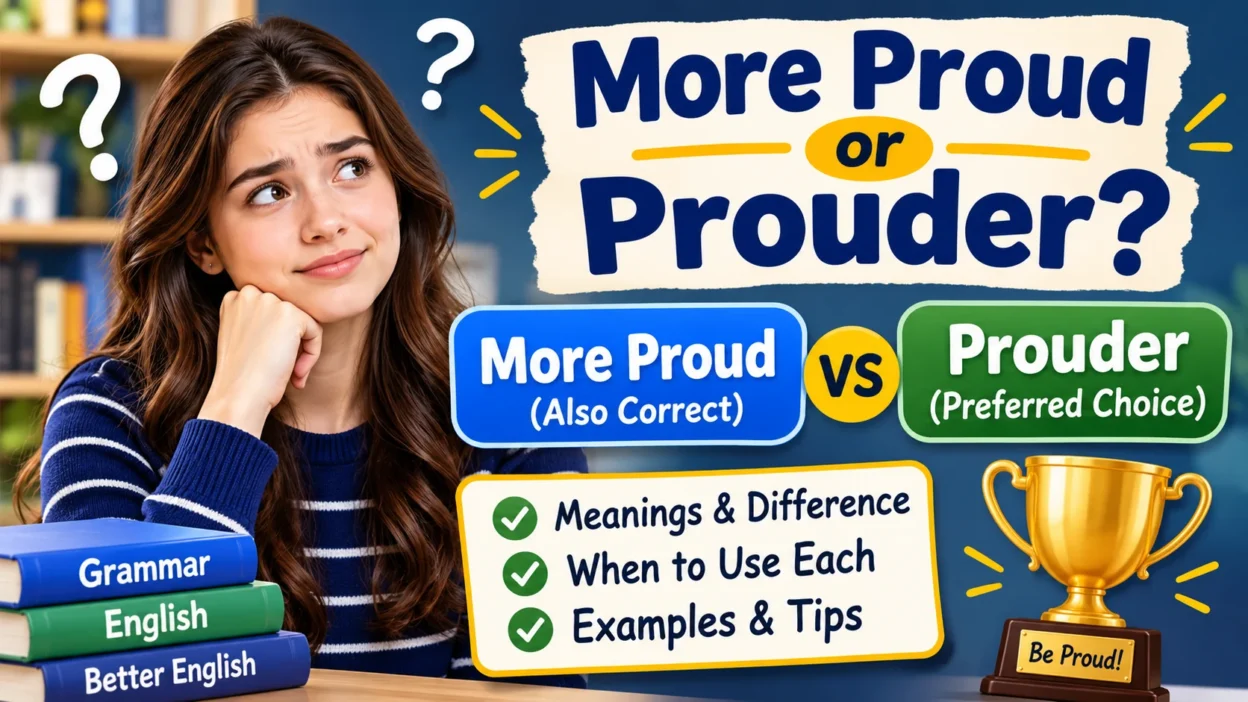
When comparing the correct expressions more proud or prouder, many English learners wonder which one sounds natural and follows standard grammar. Both expressions are understandable, but they are not equally common. The good news is that “prouder” is generally the preferred and more natural comparative form of “proud.” However, “more proud” is also grammatically acceptable in certain situations, especially when a speaker wants to add emphasis or create a particular rhythm.
Understanding the difference between these expressions can help you speak and write more confidently. if you are describing personal achievements, family relationships, professional success, or someone’s accomplishments, choosing the right comparative form makes your sentences clearer. In this guide, you will learn what each expression means, when to use it, how it works in different contexts, and which form is best for everyday English.
Quick Answer: More Proud or Prouder?
“Prouder” is generally the preferred comparative form of “proud.” It is shorter, more natural, and commonly used in everyday English. However, “more proud” is also grammatically correct and can be used for emphasis or stylistic reasons. Both expressions mean having a greater feeling of pride, but “prouder” is usually the better choice.
Why Do People Confuse More Proud and Prouder?
People confuse these expressions because English has two common ways of forming comparative adjectives:
- Adding -er to an adjective.
- Using more before an adjective.
For example:
- Tall → Taller
- Small → Smaller
- Beautiful → More beautiful
- Important → More important
Since both methods can sometimes apply to the same adjective, learners may wonder if they should say “more proud” or “prouder.”
The adjective proud has an established comparative form: prouder. Nevertheless, the expression “more proud” is not incorrect.
1. Prouder: Meaning and Usage
Prouder is the comparative form of the adjective proud. It describes someone who feels a greater sense of pride than before or compared with another person.
It is commonly used when talking about achievements, family, personal growth, success, and accomplishments.
Examples:
- I am prouder of you than ever.
- She feels prouder of her achievements today.
- My parents are prouder of me after my graduation.
- He could not be prouder of his daughter.
When Should You Use Prouder?
Use “prouder” when you want to make a natural comparison involving feelings of pride.
For example:
- I am prouder of my work this year.
- She is prouder of her son than ever.
- We are prouder of our progress now.
It is especially suitable for everyday conversations, informal writing, and professional communication.
2. More Proud: Meaning and Usage
More proud is another comparative construction using the word more before the adjective proud.
It means feeling a greater amount of pride compared with someone or something else.
Although “prouder” is generally more natural, “more proud” is grammatically acceptable.
Examples:
- I am more proud of my team than I was last year.
- She feels more proud of her achievements now.
- He is more proud of his work than his awards.
When Should You Use More Proud?
Use “more proud” when you want to emphasize the feeling of pride or when it fits the rhythm and structure of your sentence.
For example:
- I am more proud of your honesty than your success.
- She is more proud of her personal growth than her professional achievements.
- I feel more proud of what we accomplished together.
In these sentences, “more proud” can help emphasize the comparison between different sources of pride.
More Proud vs Prouder: Comparison Table
| Feature | More Proud | Prouder |
|---|---|---|
| Meaning | Greater pride | Greater pride |
| Grammar | Correct | Correct |
| Structure | More + adjective | Adjective + -er |
| Naturalness | Less common in many contexts | Generally more natural |
| Everyday English | Acceptable | Preferred |
| Formal writing | Acceptable | Preferred in most cases |
| Emphasis | Can provide emphasis | Direct comparison |
| Example | I am more proud today. | I am prouder today. |
When to Use Each Expression
Choosing between “more proud” and “prouder” depends on the sentence, tone, and intended emphasis.
Use Prouder When:
- You want a natural-sounding comparative.
- You are having an everyday conversation.
- You are comparing achievements or accomplishments.
- You want to keep your sentence simple and concise.
- You are writing a straightforward comparison.
Example: I am prouder of my progress this year.
Use More Proud When:
- You want to emphasize a particular feeling.
- You are contrasting two different sources of pride.
- It creates a better rhythm in your sentence.
- You want to highlight a specific comparison.
Example: I am more proud of your kindness than your academic success.
10+ Examples of More Proud and Prouder in Sentences
Here are practical examples to help you understand how both expressions work.
Examples Using Prouder
- I am prouder of myself than I was last year.
- My parents are prouder of me after my graduation.
- She feels prouder of her achievements every day.
- He is prouder of his team than ever before.
- We are prouder of our community’s progress.
- I could not be prouder of my younger brother.
- They became prouder of their country after the victory.
- She is prouder of her hard work than her awards.
Examples Using More Proud
- I am more proud of your honesty than your success.
- She is more proud of her personal growth than her professional achievements.
- He feels more proud of his family than his career.
- We are more proud of what we accomplished together.
- I am more proud of your determination than your final result.
Common Mistakes to Avoid
English learners sometimes make mistakes when using comparative adjectives.
Here are some common errors and their corrections.
| Incorrect or Less Natural | Better or More Natural |
|---|---|
| I am most prouder of you. | I am prouder of you. |
| She is more prouder today. | She is prouder today. |
| He feels proudest than me. | He feels prouder than me. |
| I am proudier of my work. | I am prouder of my work. |
| I am more proudest of my son. | I am proudest of my son. |
Important grammar tip: Do not combine “more” and the comparative ending “-er” in the same adjective phrase. Use either “more proud” or “prouder,” not “more prouder.”
Also, remember that proudest is the superlative form, used when comparing someone or something with an entire group.
Memory Trick: How to Remember the Difference
Use this simple trick:
– Proud → Prouder → Proudest
Think of the three forms as a progression:
- Proud: Having a feeling of satisfaction.
- Prouder: Having a greater feeling of satisfaction.
- Proudest: Having the greatest feeling of satisfaction within a group.
Remember that “more proud” is also possible, but “prouder” is usually the simplest choice for comparisons.
American vs British English
There is no major grammatical difference between American and British English when using “more proud” and “prouder.”
Both varieties recognize these expressions, and prouder is a standard comparative form in both.
| American English | British English |
|---|---|
| Prouder | Prouder |
| More proud | More proud |
| Proudest | Proudest |
The choice generally depends on sentence structure, emphasis, and personal writing style rather than regional grammar rules.
Similar Words and Related Comparative Forms
Understanding other comparative adjectives can help you become more confident with English grammar.
| Base Adjective | Comparative | Superlative |
|---|---|---|
| Proud | Prouder | Proudest |
| Tall | Taller | Tallest |
| Kind | Kinder | Kindest |
| Happy | Happier | Happiest |
| Beautiful | More beautiful | Most beautiful |
| Important | More important | Most important |
| Intelligent | More intelligent | Most intelligent |
| Confident | More confident | Most confident |
Other words related to proud include:
- Satisfied: Feeling pleased with something.
- Pleased: Feeling happy about an achievement or situation.
- Grateful: Feeling thankful for something.
- Accomplished: Having achieved something successfully.
- Honored: Feeling respect or recognition.
These words are related in meaning but are not always interchangeable with proud.
Final Verdict: More Proud or Prouder?
The correct choice is generally prouder when you want to compare feelings of pride. It is the conventional comparative form of the adjective proud and sounds natural in most everyday and formal situations.
However, more proud is also grammatically correct. You can use it when you want to emphasize a feeling, contrast different sources of pride, or create a particular sentence structure.
Best recommendation: Choose “prouder” for ordinary comparisons and use “more proud” when it better expresses your intended emphasis.
Frequently Asked Questions (FAQs)
1. Is it more proud or prouder?
Both expressions are grammatically correct, but “prouder” is generally preferred. It is the standard comparative form of “proud” and sounds more natural in most everyday conversations.
2. Is more proud grammatically correct?
Yes, “more proud” is grammatically correct. It uses the comparative structure “more + adjective.” Although “prouder” is usually more natural, “more proud” can be useful for emphasis or stylistic reasons.
3. What is the comparative form of proud?
The comparative form of “proud” is “prouder.” For example: “I am prouder of my achievements today than I was last year.”
4. What is the superlative form of proud?
The superlative form is “proudest.” It describes the highest degree of pride when comparing three or more people or things.
Example: “My parents are the proudest people in my life.”
5. Can I say I am more prouder?
No. “More prouder” is grammatically incorrect because it combines two comparative forms. Use “more proud” or “prouder” instead.
6. Is prouder more formal than more proud?
Neither expression is inherently more formal. However, “prouder” is generally the more conventional and concise choice in both formal and informal writing.
7. Is prouder used in American and British English?
Yes. “Prouder” is accepted in both American and British English. There is no significant regional difference in its meaning or grammatical usage.
Remember This
- Proud: The basic adjective.
- Prouder: The standard comparative form.
- More proud: An acceptable alternative comparative construction.
- Proudest: The superlative form.
- More prouder: Incorrect because it combines two comparative forms.
For most situations, remember this simple rule: Use “prouder” when comparing feelings of pride.
Conclusion
Both “more proud” and “prouder” are correct English expressions, but they are not equally common in everyday usage. “Prouder” is the standard comparative form of “proud” and is generally the most natural choice when comparing feelings, achievements, or personal accomplishments. It makes sentences clear, concise, and grammatically sound.
On the other hand, “more proud” is an acceptable alternative when you want to emphasize a particular feeling or create a specific contrast. Understanding how these expressions work will help you avoid common comparative adjective mistakes and communicate more confidently. When in doubt, choose prouder as your first option.

Daniel Jack is a language enthusiast and content writer who specializes in synonyms, vocabulary, and word meanings. He creates clear, engaging resources that help readers improve communication and expand their English skills.