
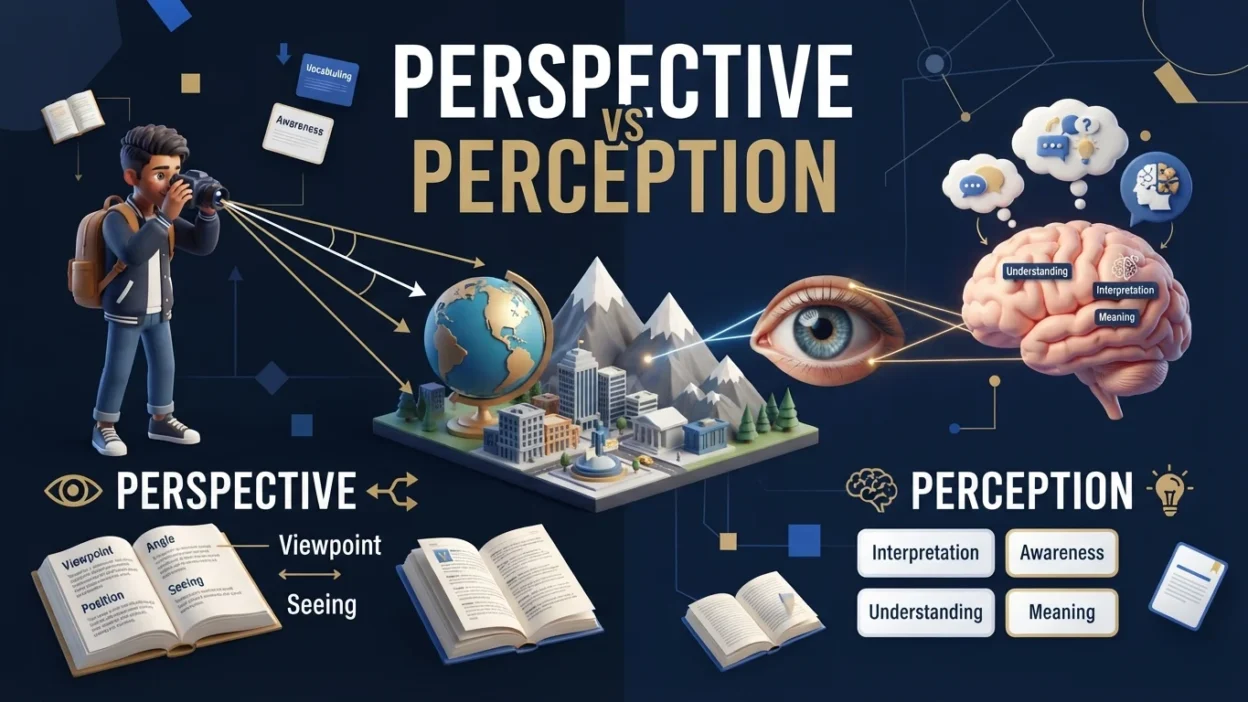
When talking about how people see, understand, or interpret the world, perspective and perception can seem interchangeable. However, they describe different ideas. Perspective is the particular way someone views or approaches a situation, while perception is the way someone notices, understands, or interprets something.
Understanding the difference between perspective vs perception can make your English more precise. These words are common in everyday conversations, academic writing, psychology, business, journalism, and discussions about opinions and experiences. Although both are connected to how we understand things, they focus on different parts of that process. This guide explains their meanings, differences, common uses, examples, and related words in simple English.
Quick Answer: Perspective vs Perception
Perspective means a particular point of view or way of looking at a situation. Perception means the way a person notices, interprets, or understands something. Your perspective can influence your perception, but the two words are not identical. In simple terms, perspective is your viewpoint, while perception is your interpretation or understanding.
Why Do People Confuse Perspective and Perception?
People confuse these words because both relate to how individuals understand the world.
For example:
- Your perspective may be shaped by your experiences.
- Your perception may be affected by what you notice or how you interpret information.
- Two people can have different perspectives about the same event.
- Two people can also perceive the same event differently.
The key difference is that perspective focuses more on a viewpoint, while perception focuses more on the process or result of interpreting something.
What Does Perspective Mean?
Perspective is a particular way of viewing, considering, or understanding a person, situation, issue, or event.
It can refer to someone’s:
- Point of view
- Attitude toward something
- Personal outlook
- Position or standpoint
- Way of considering an issue
Examples of Perspective
From my perspective, the decision was reasonable.
Here, perspective means the speaker’s point of view.
Try to see the situation from her perspective.
This means trying to understand the situation from her point of view.
Perspective can be influenced by age, culture, education, personal experiences, values, and circumstances.
What Does Perception Mean?
Perception is the way someone notices, interprets, or understands something.
It can involve information received through the senses as well as the way the mind interprets people, situations, or events.
Examples of Perception
My perception of the company changed after the meeting.
The speaker’s understanding or impression of the company changed.
People’s perception of the product is important to the business.
This refers to how people generally view or understand the product.
Perception can be influenced by experience, expectations, emotions, available information, and context.
Perspective vs Perception: Comparison Table
| Feature | Perspective | Perception |
|---|---|---|
| Basic meaning | A point of view | The way something is noticed or interpreted |
| Main idea | Viewpoint | Interpretation or understanding |
| Focus | How someone approaches or views something | How someone processes or understands something |
| Common synonym | Viewpoint | Interpretation |
| Example | From my perspective, the plan works. | My perception of the plan changed. |
| Can it change? | Yes | Yes |
| Influenced by experience? | Yes | Yes |
| Common phrase | From my perspective | Public perception |
| Typical question | “What is your point of view?” | “How do you interpret or understand it?” |
When Should You Use Perspective vs Perception?
Use perspective when you are talking about someone’s point of view or standpoint.
From a teacher’s perspective, regular practice is important.
Use perception when you are talking about someone’s interpretation, impression, or understanding.
The advertisement changed consumers’ perception of the brand.
A Simple Test
Ask yourself:
Am I talking about a viewpoint?
Use perspective.
Am I talking about how something is interpreted or understood?
Use perception.
10+ Examples of Perspective and Perception
1. Different Perspective
We have different perspectives on the problem.
Each person has a different point of view.
2. Personal Perspective
From my personal perspective, the change was necessary.
The speaker is giving their own viewpoint.
3. Change in Perspective
Traveling abroad gave her a new perspective on life.
Her way of looking at life changed.
4. Different Perception
People can have different perceptions of the same event.
People may interpret the event differently.
5. Public Perception
The company is trying to improve its public perception.
The company wants people to view it more positively.
6. Perception of Reality
Our perception of reality can be influenced by our experiences.
Our experiences can affect how we interpret what happens around us.
7. Professional Perspective
From a doctor’s perspective, rest is important.
The sentence describes a viewpoint based on the doctor’s professional position.
8. Customer Perception
Customer perception can affect how people respond to a brand.
This means customers’ impressions or interpretations of the brand.
9. Broader Perspective
Reading different opinions can give you a broader perspective.
It can help you consider an issue from more viewpoints.
10. Perception Changed
His perception of the situation changed after he learned the facts.
His understanding or interpretation changed.
11. Cultural Perspective
The issue looks different from a cultural perspective.
The sentence focuses on a particular cultural viewpoint.
12. First Impression and Perception
Her first impression influenced her perception of the company.
Her initial impression affected how she understood or viewed the company.
Common Mistakes
Mistake 1: Treating Them as Exact Synonyms
Although they overlap, perspective and perception are not exact synonyms.
Better:
From my perspective, the policy is practical.
Public perception of the policy has changed.
Mistake 2: Using “Perception” When You Mean “Point of View”
If you are simply expressing an opinion or standpoint, perspective is often more natural.
From my perspective, this is the best approach.
Mistake 3: Using “Perspective” for an Impression
When talking about how people view or interpret a person, product, organization, or situation, perception may be more precise.
The campaign improved public perception of the organization.
Mistake 4: Assuming Perception Always Means Opinion
Perception can involve sensory awareness and mental interpretation, not just personal opinion.
For example:
Color perception varies under different lighting conditions.
Here, perception relates to how the senses and brain process visual information.
Memory Trick: Perspective vs Perception
Remember:
Perspective = Point of view
Both begin with a P, and perspective tells you where someone is coming from.
Perception = Interpretation
Think of perception as how your mind takes in and understands something.
A simple formula is:
Perspective = viewpoint
Perception = interpretation
American vs British English
There is no major difference in meaning between American and British English for perspective and perception.
Both varieties commonly use:
- Perspective
- Perception
- Point of view
- Public perception
- Personal perspective
Spelling and usage do not normally change between American and British English for these two words.
Similar Words
Perspective
Depending on the context, related words include:
- Viewpoint
- Standpoint
- Outlook
- Position
- Approach
- Point of view
These words are not always interchangeable in every sentence.
Perception
Related words include:
- Interpretation
- Understanding
- Awareness
- Impression
- Recognition
- View
Again, the exact choice depends on context.
For example, impression often refers to the feeling or idea you form about something, while perception can describe the broader process of noticing and interpreting it.
Final Verdict: Perspective vs Perception
Perspective and perception are closely related but have different core meanings.
- Perspective = a particular viewpoint or way of looking at something.
- Perception = the way something is noticed, interpreted, or understood.
Your perspective can influence your perception. For example, someone with extensive experience in a particular field may approach an issue from a different perspective and therefore perceive certain details differently.
FAQs
Is perspective the same as perception?
No. Perspective means a particular point of view or standpoint, while perception means the way something is noticed, interpreted, or understood.
What is an example of perspective and perception?
“From my perspective, the job is challenging” expresses a viewpoint. “My perception of the job changed after my first week” describes a change in understanding or impression.
Can perspective affect perception?
Yes. A person’s experiences, knowledge, values, and viewpoint can influence how they interpret situations and information.
What is the difference between perception and point of view?
Point of view is generally a way of looking at or considering something. Perception focuses more on how something is noticed, interpreted, or understood.
Is perception an opinion?
Perception can include an opinion or impression, but it is broader than opinion. It can also refer to sensory awareness and mental interpretation.
What is another word for perspective?
Common alternatives include viewpoint, standpoint, outlook, and point of view, depending on the context.
What is another word for perception?
Depending on the context, alternatives include interpretation, understanding, awareness, and impression.
Can you use perspective and perception in the same sentence?
Yes. For example: “Her professional perspective influenced her perception of the problem.”
Remember This
Perspective = how you look at something.
Perception = how you notice, interpret, or understand something.
If you are talking about someone’s viewpoint, choose perspective. If you are talking about someone’s interpretation or impression, perception is usually the better word.
Conclusion
The difference between perspective vs perception becomes clearer when you focus on their central ideas. Perspective is a person’s viewpoint or standpoint, while perception is the way that person notices and interprets information or experiences. Both can be influenced by personal experience, knowledge, culture, expectations, and circumstances.
Use perspective for a point of view and perception for interpretation or understanding. Once you connect perspective with viewpoint and perception with interpretation, choosing the right word becomes much easier.

David Henry is a language enthusiast and content writer specializing in synonyms, vocabulary, and word meanings. He creates clear, engaging resources that help readers improve their writing, communication, and English skills.