
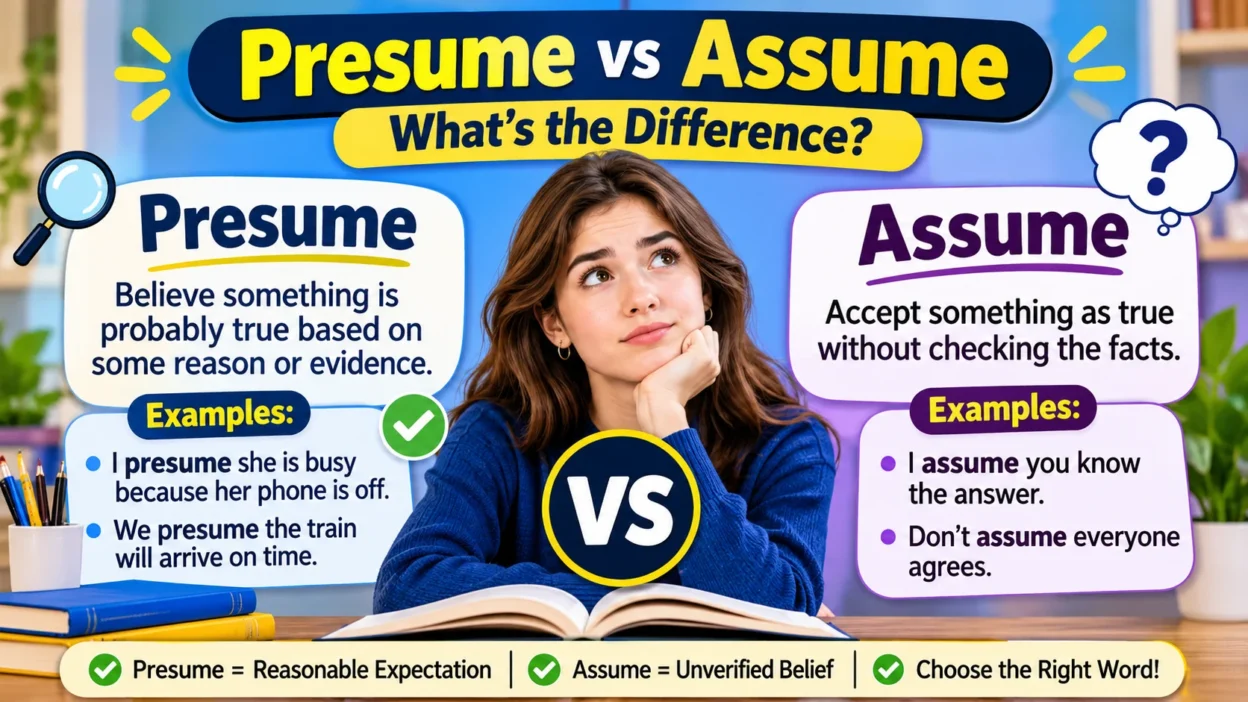
The words presume and assume are closely related because both describe believing something to be true without having complete proof. However, they are not always interchangeable. Understanding the difference between presume vs assume can help you communicate more clearly, choose the right word, and avoid common English grammar mistakes.
Although both words involve making judgments or accepting something as true, they differ slightly in how those beliefs are formed. Assume generally means accepting something as true without definite evidence, while presume often suggests that you have some reasonable evidence, probability, or justification for your belief. For example, you might assume someone is busy because they have not answered your message, but presume they are busy because you know they have an important meeting. Both words are common in everyday conversations, academic writing, professional communication, and formal English.
Quick Answer: Presume vs Assume
Assume means to accept something as true without having enough evidence or checking the facts. Presume means to believe something is probably true based on reasonable evidence, circumstances, or probability. Although they overlap, presume often sounds more formal and suggests a stronger reason for believing something.
Why Do People Confuse Presume and Assume?
People often confuse these words because they share a similar meaning: believing something without complete confirmation.
Both words can describe situations where someone makes a judgment before knowing all the facts.
However, there is a subtle difference:
- Assume: You accept something as true without necessarily having evidence.
- Presume: You believe something is likely true because you have some reason or supporting information.
For example:
- I assume he is at home. (I believe it without knowing for sure.)
- I presume he is at home because his car is outside. (I have a reason to believe it.)
The difference is not absolute. In many situations, both words can be correct, depending on the speaker’s intended meaning.
1. What Does Presume Mean?
Presume is a verb that means to believe or accept something as probably true based on available evidence, circumstances, experience, or reasonable expectations.
It often suggests that a person has a logical reason for forming an opinion, even though the information has not been completely confirmed.
Examples of Presume in Sentences
- I presume you have already finished your homework.
- She presumed that everyone knew about the meeting.
- We presume the train will arrive on time.
- He presumed that his friend was telling the truth.
- I presume you are familiar with this topic.
- The company is presumed to be financially stable.
- They presumed that the road was safe.
- I presume you have received my email.
When Should You Use Presume?
Use presume when:
- You have some evidence supporting your belief.
- Something seems likely based on circumstances.
- You are making a reasonable prediction.
- You want to express a belief in a formal or professional context.
- You are discussing legal or official expectations.
Example: I presume she is qualified because she has several years of experience.
Here, the speaker has a reason to believe that she is qualified.
2. What Does Assume Mean?
Assume is a verb that means to accept something as true without checking if it is actually correct or having sufficient proof.
It is commonly used in everyday English, professional conversations, academic discussions, and general communication.
An assumption may be based on personal beliefs, expectations, incomplete information, or guesses.
Examples of Assume in Sentences
- I assumed you were coming to the party.
- Don’t assume that everyone agrees with you.
- She assumed he was angry because he was quiet.
- They assumed the shop was open.
- I assume you understand the instructions.
- He assumed that the information was correct.
- Never assume something without checking the facts.
- We assumed they had already left.
When Should You Use Assume?
Use assume when:
- You accept something as true without confirmation.
- You are making a guess based on limited information.
- You want to describe an expectation.
- You are discussing an unverified belief.
- You want to warn someone against jumping to conclusions.
Example: I assumed you were busy because you didn’t answer my call.
The speaker has formed a belief without confirming if the person was actually busy.
Presume vs Assume: Comparison Table
| Feature | Presume | Assume |
|---|---|---|
| Basic meaning | Believe something is likely true | Accept something as true |
| Evidence | Often some supporting evidence | May have little or no evidence |
| Certainty | Often suggests reasonable probability | Depends on the situation |
| Tone | Often more formal | Common in everyday English |
| Usage | Formal and informal contexts | Formal and informal contexts |
| Example | I presume he is qualified. | I assume he is qualified. |
| Main idea | Reasonable expectation | Unverified belief |
Important: The distinction is a general tendency, not a strict grammar rule. Both words can be used with or without strong evidence, depending on context.
When Should You Use Presume or Assume?
Choosing between these words becomes easier when you understand the situation.
Use Presume When You Have a Reason to Believe Something
Choose presume when your belief comes from circumstances, evidence, or reasonable expectations.
Examples:
- I presume the meeting has started because everyone is inside.
- We presume the information is accurate based on the available records.
- She presumed he was experienced because of his qualifications.
Use Assume When You Accept Something Without Confirmation
Choose assume when you believe something without checking the facts.
Examples:
- I assumed you knew about the changes.
- Don’t assume that he is guilty.
- She assumed the restaurant was open without checking.
Can Presume and Assume Be Used Interchangeably?
Yes, sometimes. Both words can express an unconfirmed belief.
For example:
- I presume he is at work.
- I assume he is at work.
Both sentences are grammatically correct. However, presume may suggest a reasonable expectation, while assume can sound more like an unverified guess.
10+ Examples of Presume vs Assume in Sentences
Here are practical examples that show how these words work in everyday English.
| Presume | Assume |
|---|---|
| I presume you know the answer. | I assume you know the answer. |
| We presume she is coming. | We assume she is coming. |
| I presume the shop is closed because the lights are off. | I assumed the shop was closed without checking. |
| He presumed the information was reliable. | He assumed the information was reliable. |
| I presume they have arrived safely. | I assume they have arrived safely. |
| She presumed he was responsible. | She assumed he was responsible. |
| We presume the results are accurate. | We assume the results are accurate. |
| I presume you received the invitation. | I assumed you received the invitation. |
| They presumed the road was safe. | They assumed the road was safe. |
| I presume everything is ready. | I assume everything is ready. |
More Examples in Context
1. Professional communication
- Presume: I presume the manager has approved the proposal.
- Assume: I assumed the manager had approved the proposal.
2. Everyday conversation
- Presume: I presume you’re tired after such a long journey.
- Assume: I assumed you were tired after such a long journey.
3. Academic writing
- Presume: Researchers presume the results are consistent with the theory.
- Assume: Researchers assume that the variables remain constant.
Common Mistakes When Using Presume and Assume
Even advanced English learners sometimes use these words incorrectly. Here are some mistakes to avoid.
Mistake 1: Thinking They Have Exactly the Same Meaning
Although they are similar, presume often suggests a reasonable basis for believing something, whereas assume can describe accepting something without verification.
Better approach: Consider if you want to emphasize supporting reasons or an unconfirmed belief.
Mistake 2: Assuming Presume Always Requires Evidence
Presume does not always require strong evidence. It can also describe expectations, probabilities, and beliefs based on circumstances.
Mistake 3: Thinking Assume Is Always Informal
Assume is perfectly acceptable in academic, professional, and formal writing.
Example: We assume that all participants received the same instructions.
Mistake 4: Using Presume When You Mean Presumptuous
Presume and presumptuous are related, but they are not interchangeable.
- Presume: To believe something is probably true.
- Presumptuous: Behaving in a way that is too confident or disrespectful.
Example: It was presumptuous of him to make that decision without asking.
Memory Trick: How to Remember Presume vs Assume
Use this simple memory trick:
- Presume = Probability: You have a reason to believe something is likely true.
- Assume = Accept: You accept something as true without confirming it.
Think of these two examples:
- I presume it will rain because the sky is dark.
- I assume it will rain without checking the weather.
This simple distinction can help you remember which word fits your sentence.
Presume vs Assume in American and British English
Both presume and assume are used in American English and British English.
There is no major spelling difference between the two varieties.
| Word | American English | British English |
|---|---|---|
| Presume | Presume | Presume |
| Assume | Assume | Assume |
The meanings and general usage are also similar in both varieties.
For example:
- American English: I assume he is already there.
- British English: I presume he is already there.
Both sentences are natural in their respective contexts, although either word can be used in both varieties.
Similar Words to Presume and Assume
Several English words are related to presume and assume. However, each has its own meaning and usage.
| Word | Meaning | Example |
|---|---|---|
| Suppose | Think something is probably true | I suppose he is busy. |
| Guess | Form an opinion without certainty | I guess she is at home. |
| Believe | Accept something as true | I believe your story. |
| Expect | Think something will happen | I expect him to arrive soon. |
| Infer | Reach a conclusion from evidence | I inferred that she was upset. |
| Speculate | Form an opinion without complete information | They speculated about the results. |
| Conclude | Reach a decision after considering facts | We concluded that the plan was successful. |
Presume vs Suppose
Presume often suggests a reasonable expectation, while suppose generally expresses an opinion or possibility.
Example:
- I presume he knows the answer.
- I suppose he knows the answer.
Assume vs Infer
Assume means accepting something as true without necessarily verifying it. Infer means reaching a conclusion using available evidence.
Example:
- I assumed she was upset.
- I inferred she was upset from her expression.
Final Verdict: Presume vs Assume
The main difference between presume and assume is the way a person forms a belief.
- Presume generally means believing something is probably true based on reasonable expectations, circumstances, or supporting evidence.
- Assume means accepting something as true without confirming it, sometimes with little or no evidence.
Both words are grammatically correct in many of the same situations. However, choosing the right one helps communicate your intended meaning more precisely.
Frequently Asked Questions (FAQs)
1. What is the main difference between presume and assume?
The main difference is that presume often suggests a reasonable basis for believing something is true, while assume means accepting something as true without confirmation. Both words can describe beliefs that are not completely verified.
2. Is presume more formal than assume?
Generally, presume sounds slightly more formal than assume. However, both words are appropriate in professional, academic, and everyday communication.
3. Can I use presume and assume interchangeably?
Yes, in many situations. Both words can express an unconfirmed belief. However, presume may suggest a stronger reason or expectation, while assume can emphasize an unverified belief.
4. Does presume mean the same as guess?
Not exactly. Presume usually suggests a reasonable expectation or belief, while guess often describes forming an opinion without much information.
5. Is it correct to say “I presume”?
Yes. “I presume” is grammatically correct and commonly used to express a belief or expectation.
Example: I presume you have completed the assignment.
6. Is assume a negative word?
No. Assume is not inherently negative. However, it can have a negative meaning when someone accepts something as true without checking the facts.
Example: Don’t assume that everyone agrees with you.
7. What is the difference between presume, assume, and infer?
- Presume: Believe something is probably true based on reasonable expectations.
- Assume: Accept something as true without confirmation.
- Infer: Reach a conclusion based on available evidence.
Example:
- I presume he is tired.
- I assume he is tired.
- I infer he is tired from his body language.
Remember This
- Presume often suggests a reasonable basis for a belief.
- Assume means accepting something as true without confirmation.
- Presume can sound more formal than assume.
- Both words are used in American and British English.
- Neither word guarantees that something is actually true.
Quick tip: Remember Presume = Probability and Assume = Accept without checking.
Conclusion
Understanding the difference between presume and assume can improve your English vocabulary and make your communication more accurate. Although both words describe accepting something as true without complete certainty, presume often suggests a reasonable expectation, while assume can refer to a belief formed without checking the facts. Recognizing this small difference will help you choose the right word in everyday conversations, academic writing, and professional communication.
The next time you are unsure which word to use, consider the reason behind your belief. If you have circumstances or supporting information that make something seem likely, presume may be appropriate. If you are simply accepting something as true without confirmation, assume is often the better choice. With regular practice, you can use both words naturally and confidently.

David Henry is a language enthusiast and content writer specializing in synonyms, vocabulary, and word meanings. He creates clear, engaging resources that help readers improve their writing, communication, and English skills.