Choosing between herself, herselves, and her-self can be confusing, especially when writing English sentences. Although these words look similar, they do not have the same grammatical status. Understanding their spelling, meaning, and correct usage will help you avoid common English grammar mistakes.
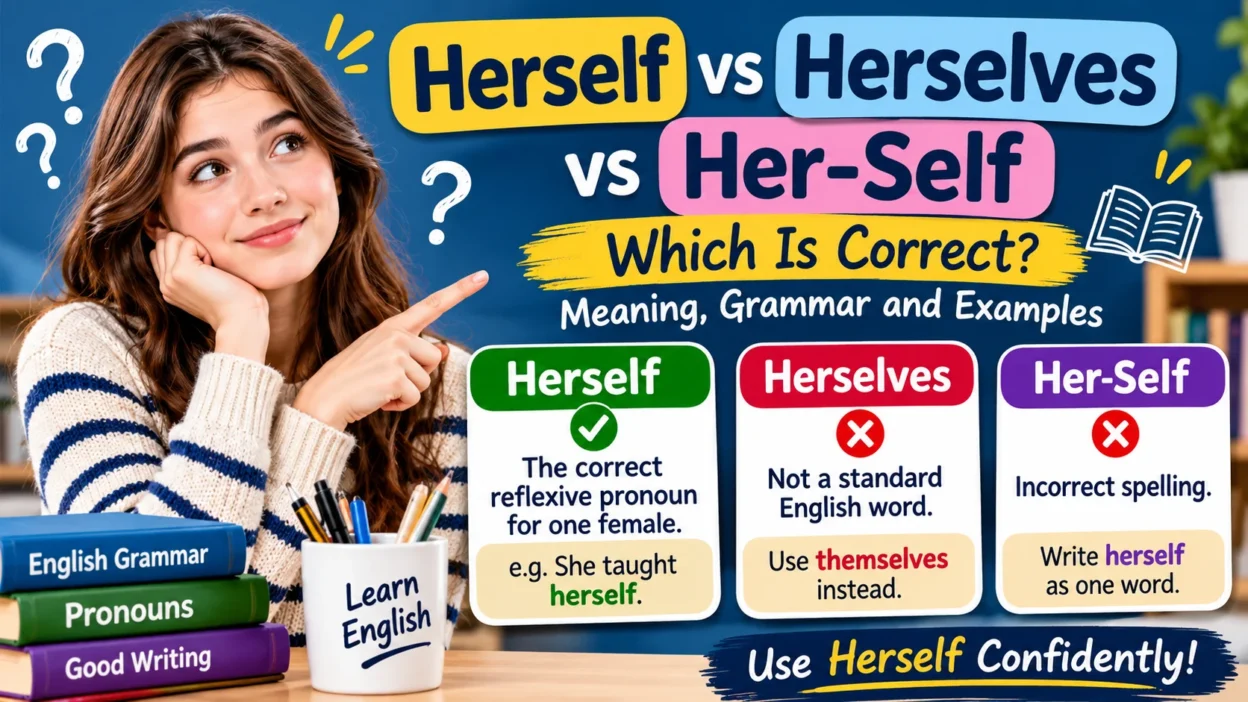
The most important thing to remember is that herself is the standard and correct reflexive pronoun used when referring to one female person. Herselves is not a standard English word, while her-self is generally an incorrect spelling of herself. These distinctions are important for students, ESL learners, writers, and anyone who wants to improve their English.
Quick Answer: Herself vs Herselves vs Her-Self
- Herself: The correct standard reflexive pronoun for one female person. Example: She taught herself to cook.
- Herselves: Not a standard English pronoun. The correct plural reflexive pronoun is themselves.
- Her-self: Generally an incorrect spelling. The correct spelling is herself, written as one word.
Remember: Use herself for one woman or girl, and themselves for multiple people.
Why Do People Confuse Herself, Herselves, and Her-Self?
People often confuse these expressions because they contain the word her and appear to follow similar grammatical patterns.
For example, English has several reflexive pronouns:
- Myself
- Yourself
- Himself
- Herself
- Itself
- Ourselves
- Yourselves
- Themselves
Because ourselves, yourselves, and themselves end in -selves, some people assume that herself should become herselves when referring to more than one female person.
However, English does not form plural reflexive pronouns by simply adding an s to every singular form.
Another source of confusion is the hyphen in her-self. Some writers mistakenly believe that reflexive pronouns should be separated into two parts. Standard English spelling does not use a hyphen in herself.
1. Herself: Meaning, Definition, and Correct Usage
Herself is a singular reflexive pronoun used to refer to a female person or animal previously mentioned in a sentence.
It usually refers back to the subject of the sentence. It can also be used for emphasis.
When Should You Use Herself?
Use herself in these situations:
1. When the subject and object refer to the same female person
- She blamed herself for the mistake.
- Maria looked at herself in the mirror.
- She prepared herself for the examination.
2. When emphasizing a female person
- The manager herself welcomed the visitors.
- Sarah herself completed the entire project.
- She herself made the final decision.
3. When referring to a female person acting independently
- She lives by herself.
- She completed the assignment by herself.
- The little girl dressed herself.
Examples of Herself in Sentences
- She taught herself how to play the piano.
- Emma introduced herself to the new students.
- She looked at herself in the mirror.
- The woman prepared herself for the interview.
- Sarah completed the project herself.
- She accidentally hurt herself while cooking.
- My sister bought herself a new laptop.
- She believes in herself.
- The teacher herself explained the lesson.
- She managed to solve the problem by herself.
Key point: Herself is the standard spelling and is used for a singular female referent.
2. Herselves: Meaning and Correct Usage
Herselves is not recognized as a standard English reflexive pronoun.
Some people mistakenly use it as the plural form of herself. However, standard English uses themselves as the plural reflexive pronoun for people of any gender.
For example:
Correct: The girls prepared themselves for the competition.
Incorrect: The girls prepared herselves for the competition.
Why Is Herselves Incorrect?
English reflexive pronouns have established forms. Although some singular pronouns end in -self and plural pronouns end in -selves, their plural forms are not always created by simply adding an s.
For example:
- Himself → Themselves (not himselves)
- Herself → Themselves (not herselves)
- Itself → Themselves (not itselves)
When referring to several women or girls, use themselves.
Correct Examples Using Themselves
- The girls introduced themselves to the teacher.
- The women prepared themselves for the meeting.
- My sisters taught themselves to swim.
- The female students organized themselves into groups.
- They enjoyed themselves at the party.
Key point: Avoid herselves in standard English writing and speaking. Use themselves instead.
3. Her-Self: Meaning and Correct Usage
Her-self is generally an incorrect spelling of the standard English reflexive pronoun herself.
In normal English writing, herself is written as one word without a hyphen.
Why Is Her-Self Incorrect?
Reflexive pronouns are established single-word forms. They are not normally separated with hyphens.
Compare these examples:
- Herself — Correct
- Her-self — Incorrect
- Myself — Correct
- My-self — Incorrect
- Himself — Correct
- Him-self — Incorrect
Correct Examples Using Herself
- She completed the assignment herself.
- She introduced herself to everyone.
- Maria prepared herself for the journey.
- She wanted to prove herself.
- The woman looked after herself.
Key point: Write herself as one word. Do not insert a hyphen.
Herself vs Herselves vs Her-Self: Comparison Table
| Word | Correct? | Meaning or usage |
|---|---|---|
| Herself | Yes | Singular female reflexive pronoun |
| Herselves | No | Nonstandard plural form |
| Her-self | No | Incorrect spelling of herself |
| Themselves | Yes | Plural reflexive pronoun |
The main distinction is that herself is a standard English word, whereas herselves and her-self should generally be avoided.
When Should You Use Each Word?
Knowing the grammatical rules makes choosing the correct word much easier.
Use Herself When:
- Referring to one female person.
- The subject and object refer to the same person.
- Emphasizing a female person.
- Describing someone doing something independently.
Examples:
- She bought herself a dress.
- The principal herself announced the results.
- She completed the work by herself.
Use Themselves Instead of Herselves When:
- Referring to multiple women or girls.
- Referring to a group of people.
- Using singular they as a gender-neutral pronoun.
Examples:
- The women introduced themselves.
- The girls enjoyed themselves.
- Each student should prepare themselves.
Avoid Her-Self When:
- Writing formal emails.
- Preparing academic assignments.
- Writing articles or professional documents.
- Communicating in standard English.
Use herself instead.
10+ Examples: Herself vs Herselves vs Her-Self in Sentences
Here are practical examples to help you understand the differences.
| Incorrect or intended expression | Correct sentence |
|---|---|
| She taught herselves. | She taught herself. |
| The girls prepared herselves. | The girls prepared themselves. |
| She looked at her-self. | She looked at herself. |
| Maria introduced her-self. | Maria introduced herself. |
| The women enjoyed herselves. | The women enjoyed themselves. |
| She blamed her-self. | She blamed herself. |
| The sisters dressed herselves. | The sisters dressed themselves. |
| She completed it her-self. | She completed it herself. |
| The female students organized herselves. | The female students organized themselves. |
| She bought a gift for her-self. | She bought a gift for herself. |
| The girls protected herselves. | The girls protected themselves. |
| She believes in her-self. | She believes in herself. |
Additional Correct Sentences
- She taught herself English without attending a formal class.
- The woman encouraged herself to keep moving forward.
- The girls enjoyed themselves during the school trip.
- She made herself a cup of coffee.
- They introduced themselves before the presentation.
Common Mistakes to Avoid
English learners sometimes make these mistakes when using reflexive pronouns.
Mistake 1: Using herselves as a plural pronoun
Incorrect: The women prepared herselves.
Correct: The women prepared themselves.
Mistake 2: Adding a hyphen to herself
Incorrect: She completed the task her-self.
Correct: She completed the task herself.
Mistake 3: Using herself for multiple women
Incorrect: The girls introduced herself.
Correct: The girls introduced themselves.
Mistake 4: Confusing her with herself
Incorrect: She bought a present for herself? (This is actually correct when she is buying it for her own benefit.)
Compare:
- She bought her a present. (The present is for another female person.)
- She bought herself a present. (The present is for her own benefit.)
Mistake 5: Forgetting reflexive pronoun agreement
Incorrect: Maria and Anna prepared herself.
Correct: Maria and Anna prepared themselves.
Memory Trick: How to Remember the Correct Word
Use this simple memory trick:
- One female person = Herself
- Multiple people = Themselves
- Hyphen = Not needed
Think of these examples:
- She helped herself. (One person)
- They helped themselves. (More than one person)
- She helped her-self. (Incorrect spelling)
A simple rule to remember is: Herself is one word, and themselves is the standard plural form.
American vs British English: Is There Any Difference?
There is no spelling difference between American and British English when using herself.
Both varieties follow the same standard spelling and grammatical rules.
| Expression | American English | British English |
|---|---|---|
| Herself | Correct | Correct |
| Herselves | Nonstandard | Nonstandard |
| Her-self | Incorrect | Incorrect |
| Themselves | Correct | Correct |
For example:
- American English: She prepared herself for the exam.
- British English: She prepared herself for the exam.
The spelling and usage are identical in both varieties.
Similar Words and Related Reflexive Pronouns
Understanding other reflexive pronouns can help you use herself correctly.
| Reflexive pronoun | Example |
|---|---|
| Myself | I taught myself Spanish. |
| Yourself | You should believe in yourself. |
| Himself | He introduced himself. |
| Herself | She prepared herself. |
| Itself | The door closed by itself. |
| Ourselves | We enjoyed ourselves. |
| Yourselves | You should prepare yourselves. |
| Themselves | They introduced themselves. |
These pronouns refer back to the subject or emphasize the person or thing being discussed.
Final Verdict: Herself vs Herselves vs Her-Self
The correct choice in standard English is herself when referring to one female person.
- Herself: Correct singular reflexive pronoun.
- Herselves: Nonstandard; use themselves for plural references.
- Her-self: Incorrect spelling; write herself as one word.
If you are writing an academic assignment, email, article, or everyday message, choose herself whenever you need the singular female reflexive pronoun.
Frequently Asked Questions (FAQs)
1. Is herselves a real English word?
Herselves is not a standard English reflexive pronoun. The correct plural reflexive pronoun is themselves, which can refer to a group of women, men, or people of different genders.
2. Is herself one word or two words?
Herself is one word. It should not be separated into two words or connected with a hyphen. The standard spelling is always herself.
3. What is the plural of herself?
The standard plural equivalent of herself is themselves. For example, use “She prepared herself” for one woman and “They prepared themselves” for multiple people.
4. Is her-self grammatically correct?
No. Her-self is generally an incorrect spelling of herself. Standard English reflexive pronouns are written as single words without hyphens.
5. Can I use themselves for a group of women?
Yes. Themselves is correct for a group of women or girls. For example: “The women introduced themselves to the audience.”
6. What is the difference between her and herself?
Her is an object pronoun or possessive determiner, depending on its use. Herself is a reflexive or emphatic pronoun.
Examples:
- I called her. (Object pronoun)
- I bought her a book. (Object pronoun)
- She bought herself a book. (Reflexive pronoun)
7. Is herself correct in American and British English?
Yes. Herself is spelled and used the same way in American and British English. Neither variety uses herselves or her-self as standard alternatives.
Remember This
- Use herself for one female person.
- Use themselves for multiple people.
- Avoid herselves because it is not a standard English pronoun.
- Avoid her-self because the standard spelling has no hyphen.
- Remember that herself is always written as one word.
Conclusion
Understanding the difference between herself, herselves, and her-self is simple once you know the rules of English reflexive pronouns. Herself is the correct singular form used when referring to one female person. It can also emphasize the person performing an action. On the other hand, herselves is not a standard English pronoun, and her-self is an incorrect spelling.
To write clearly and confidently, use herself for one female person and themselves for multiple people. Avoid unnecessary hyphens and nonstandard forms. Practicing these simple rules will help you improve your grammar and communicate more naturally in English.

David Henry is a language enthusiast and content writer specializing in synonyms, vocabulary, and word meanings. He creates clear, engaging resources that help readers improve their writing, communication, and English skills.