
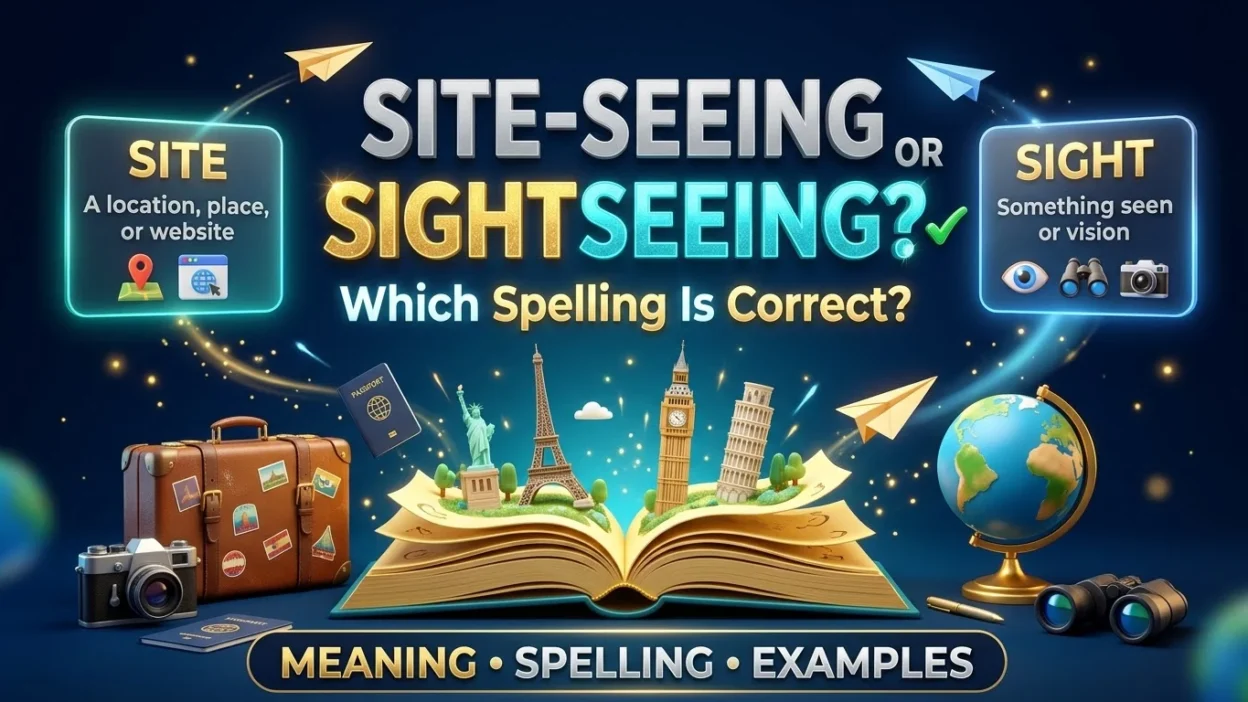
If you are unsure if to write site-seeing or sightseeing, you are not alone. These expressions look and sound similar, but only one is the standard spelling when talking about visiting interesting places, exploring tourist attractions, or enjoying a trip. The correct word is sightseeing, written as one word. It refers to the activity of visiting famous, historic, or interesting places, especially when traveling.
The confusion happens because the word site refers to a location or place, while sight refers to something you see. Since sightseeing involves looking at beautiful views, landmarks, museums, and other attractions, the correct spelling uses sight, not site. Understanding this small difference can help you avoid spelling mistakes in travel blogs, school assignments, emails, and everyday conversations. In this guide, you will learn the meanings, differences, examples, and correct usage of both expressions.
Quick Answer
Sightseeing is the correct spelling when referring to visiting interesting places and tourist attractions. It is written as one word. Site-seeing is generally a misspelling of sightseeing, although the separate words site and seeing can appear together in other grammatical contexts.
Why Do People Confuse Site-Seeing and Sightseeing?
People often confuse these expressions because they sound almost identical when spoken.
However, their spelling and meanings are different:
- Sight: Something you see or look at.
- Site: A particular place or location.
- Seeing: The act of looking at something.
Because sightseeing involves visiting places to see their attractions, some people mistakenly write site-seeing instead of sightseeing.
The key is to remember that sightseeing comes from the word sight, not site.
1. Sightseeing: Meaning, Definition, and Usage
Sightseeing is a noun that describes the activity of visiting interesting, famous, or beautiful places, especially as a tourist.
It usually involves exploring landmarks, historical buildings, museums, monuments, natural attractions, and popular destinations.
Examples:
- We went sightseeing around London.
- Sightseeing is one of my favorite activities when traveling.
- They spent the afternoon sightseeing in Paris.
- Our sightseeing tour included several famous landmarks.
When Should You Use Sightseeing?
Use sightseeing when discussing:
- Visiting tourist attractions.
- Exploring famous cities and landmarks.
- Taking guided city tours.
- Visiting historical monuments.
- Discovering beautiful natural locations.
- Enjoying interesting places while traveling.
Common expressions:
- Sightseeing tour
- Sightseeing bus
- Sightseeing trip
- Sightseeing destination
- Sightseeing activities
- City sightseeing
2. Site-Seeing: Meaning, Definition, and Usage
Usually incorrect
Site-seeing is not the standard spelling of the travel-related word. If you want to describe visiting tourist attractions, you should write sightseeing.
The confusion comes from the word site, which means a particular location or place.
For example:
- Construction site
- Historical site
- Website
- Archaeological site
Although site is a correct English word, adding seeing and a hyphen does not create the standard spelling for tourist activities.
Incorrect:
- We went site-seeing during our vacation.
- I enjoy site-seeing in different countries.
Correct:
- We went sightseeing during our vacation.
- I enjoy sightseeing in different countries.
Site-Seeing vs Sightseeing: Comparison Table
| Feature | Site-Seeing | Sightseeing |
|---|---|---|
| Spelling | Nonstandard for this meaning | Correct |
| Meaning | Usually a misspelling | Visiting attractions |
| Word type | Not standard in this usage | Noun |
| Travel context | Avoid | Appropriate |
| Formal writing | Incorrect for this meaning | Correct |
| Example | Site-seeing in Rome | Sightseeing in Rome |
When Should You Use Each?
Use Sightseeing When:
You are talking about tourism, travel, and visiting interesting places.
Examples:
- We planned a sightseeing tour of New York.
- Sightseeing made our vacation memorable.
- The city offers excellent sightseeing opportunities.
Use Site and Seeing Separately When:
You genuinely mean looking at or observing a particular site.
For example:
- We are seeing the construction site tomorrow.
- The students are seeing the historical site during their school trip.
Notice that these sentences use site and seeing as separate grammatical words. They do not use site-seeing as an alternative spelling of sightseeing.
10+ Examples of Sightseeing in Sentences
Here are 15 practical examples to help you understand the correct usage.
- We went sightseeing during our summer vacation.
- Sightseeing in Rome was an unforgettable experience.
- My family enjoys sightseeing whenever we visit a new country.
- They booked a sightseeing tour of the city.
- We spent the entire morning sightseeing around London.
- The sightseeing bus took us to several famous attractions.
- She loves sightseeing and taking photographs of historical buildings.
- Our sightseeing trip included museums and beautiful parks.
- Tourists visit the city for its sightseeing opportunities.
- We enjoyed sightseeing along the beautiful coastline.
- He prefers sightseeing to shopping when traveling.
- The guide organized a sightseeing tour for international visitors.
- They went sightseeing after checking into their hotel.
- Sightseeing helped us discover the city’s rich history.
- I would like to spend another day sightseeing in Paris.
Common Mistakes to Avoid
English learners and even native speakers sometimes make these mistakes.
1. Writing site-seeing instead of sightseeing
Incorrect: We went site-seeing in Italy.
Correct: We went sightseeing in Italy.
2. Adding an unnecessary hyphen
Incorrect: Our sight-seeing trip was wonderful.
Correct: Our sightseeing trip was wonderful.
3. Writing sightseeing as two words
Incorrect: We enjoyed sight seeing in London.
Correct: We enjoyed sightseeing in London.
4. Confusing sight with site
- Sight means something you see.
- Site means a location or place.
5. Using sightseeing as a verb
Incorrect: We sightseeing around the city.
Correct: We went sightseeing around the city.
Memory Trick: How to Remember Sightseeing
Here is an easy way to remember the correct spelling:
Sightseeing = Sight + Seeing
Think about what tourists do when they travel: they see beautiful sights, famous landmarks, and interesting attractions.
Remember:
- Sight = Something you see.
- Site = A location.
- Sightseeing = Visiting places to see interesting things.
Whenever you talk about tourism, remember to use sightseeing.
American vs British English
There is no spelling difference between American and British English for this word.
Both varieties use sightseeing as the standard spelling.
| English Variety | Correct Spelling | Example |
|---|---|---|
| American English | Sightseeing | We went sightseeing in Chicago. |
| British English | Sightseeing | We went sightseeing in Manchester. |
Whether you are writing for an American, British, Australian, or international audience, sightseeing is the correct spelling.
Similar Words Related to Sightseeing
Understanding related vocabulary can help you improve your travel-related English.
| Word | Meaning |
|---|---|
| Tourism | The activity of traveling for pleasure or business |
| Travel | Going from one place to another |
| Exploration | Visiting or investigating unfamiliar places |
| Excursion | A short journey, usually for pleasure |
| Tour | A journey to visit different places |
| Landmark | A famous or important place or structure |
| Attraction | A place that visitors find interesting |
| Outing | A short trip for enjoyment |
| Adventure | An exciting or unusual experience |
| Vacation | A period spent away from regular work or studies |
Frequently Asked Questions (FAQs)
1. Is it site-seeing or sightseeing?
Sightseeing is the correct spelling when referring to visiting tourist attractions. Site-seeing is a nonstandard spelling for this meaning.
2. Is sightseeing one word or two?
Sightseeing is one word. It should not be written as two separate words or hyphenated when referring to tourism.
3. Why is sightseeing spelled with sight instead of site?
The word comes from sight, which refers to something you see. Sightseeing describes the activity of visiting places to enjoy their views and attractions.
4. Is sightseeing a noun or a verb?
Sightseeing is primarily used as a noun or a gerund (an -ing form functioning as a noun).
Example: Sightseeing is popular among tourists.
5. What is the meaning of sightseeing?
Sightseeing means visiting interesting, famous, or beautiful places, especially while traveling for pleasure.
6. Is sight-seeing ever correct?
Sight-seeing is an occasional older or nonstandard variant, but modern standard English generally uses sightseeing as one word. Use the closed spelling in everyday and formal writing.
7. What is a sightseeing tour?
A sightseeing tour is an organized trip that allows visitors to explore popular attractions, landmarks, historical locations, or other interesting places.
Remember This
- Sightseeing is the correct standard spelling.
- Site-seeing is generally incorrect when referring to tourism.
- Sight means something you see.
- Site means a particular location.
- Always write sightseeing as one word without a hyphen.
Conclusion
The difference between site-seeing and sightseeing is simple once you understand the meaning of each word. Sightseeing is the correct spelling when discussing travel, tourism, and visiting interesting places. It refers to exploring famous landmarks, historical attractions, beautiful landscapes, and other destinations.
Remember that sightseeing comes from the word sight, meaning something you see, rather than site, meaning a location. if you are writing a travel blog, completing an assignment, or describing your vacation, use sightseeing as one word. This small spelling detail will make your English writing clearer and more accurate.

Alexander Eric is the Administrator of SynonymLot, dedicated to providing accurate synonyms, vocabulary resources, and language tools. He enjoys helping readers improve writing, communication, and English word knowledge daily.